Museum of early consumer electronics and 1st achievements
www.rewindmuseum.com
Vintage satellite. (Receivers with knobs on!) Scroll down. Long page.
DX Antenna DSB-700
Connexions CX2450 & CX2460
Echostar SR-4500
Echostar SR-3500
Wilson YM 450
Wilson YM 450
Anderson Scientific ST1010
Uniden UST-1000
Drake 320E
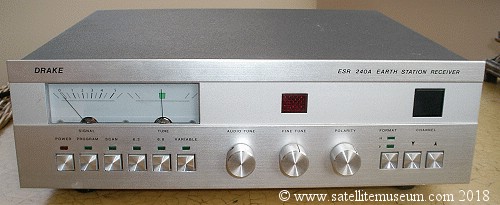
Drake ESR240
Drake ESR4240E
Rockdale TR12E & SLC-7
Uniden UST-7007
Discus Elipse
Skyscan K1A
Satcom 7700
Bennetts 2026L
Triax 2000S
B&O Beosatrx
PDS Rainbow
Salora XLE 8901
Nokia 5914
Panasonic TU-S100
Zeta Antenna
Echostar SR-50
Chaparral Monterey
Motorised History
BSB
Philips BSB
Squarials
Amstrad SRX200
Amstrad SRX400
Cards
Blind search
Manhattan ST 550
Echostar DVR-7000
Zeta arm
Zeta antenna
LNBs
You can scroll down and see some of the exhibits,
however it is best to go to our dedicated site at -
www.satellitemuseum.com
Very few museums deal with satellite products but since we have had a satellite business since 1989
this was easy for us. At the time we were able to find receivers from the mid 1980s.
The earliest receivers had knobs on and either had no wireless remote control or bulky simple handsets.
Other early, interesting, landmark satellite products are also included below. Dates are included.
Click here to go to "A History of Satellite TV".
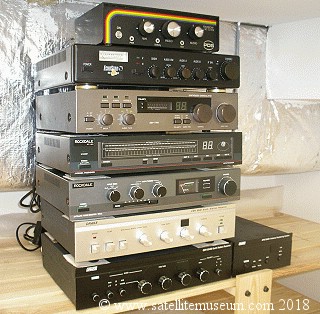
Some of the "Knobs-on" collection.
When we started in the satellite industry in 1989, receivers did not have knobs on. They were, even
then, remote control, but when customers were upgrading at the end of the 80s and beginning of the 90s,
they were upgrading from receivers with knobs on and so we took the opportunity of keeping some
of them. (Otherwise they would have been thrown away).
Domestic satellite receivers with knobs on would first become availble in 1985.
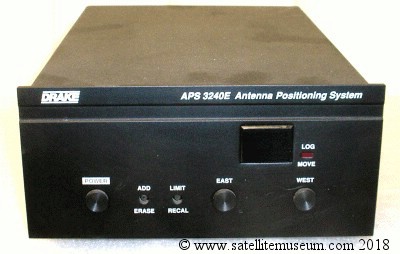
Pictured above, bottom to top, Drake ESR3240 receiver with Drake APS3240E 36 volt positioer to the right of it.
Silver Drake 320E (earlier model than the 3240), Rockdale TR12E, Rockdale AP100 36 volt positioner,
Satcom 7700, Echostar SR-50, Rainbow 12 volt receiver. This last one was bought new at the time as
I found it very interesting and could not resist it, even though I had no plans to use it!

1985
May 1985. DX Antenna DSB-700 satellite
receiver with DSB-400 36V dish positioner.
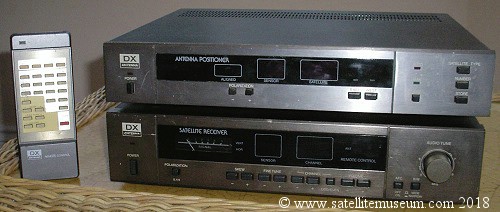
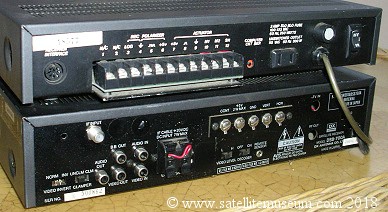
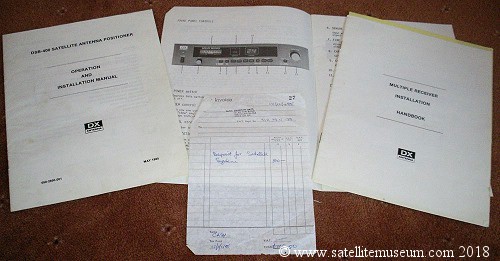
The Date on the DBS-700 manual is May 1985. It is likely that this represents the date that
manufacturing of this receiver began.
The manufacturing date on the receiver's serial plate is Oct. 1985.
A deposit for the full system was paid in Dec. 1985 and the final invoice is dated 6th Jan. 1986
The customer was from Westcliff-On-Sea, Essex, England and the manuals and the receipt are
shown above. It is unusual to find that all of the paper work is with the receiver.
The purchase price of the DBS-700 was £437.50 It was supplied with a 1.5m motorised
dish (at extra cost.) The DSB-400 36V positioner was £350.00
The papers include an advert which details a DSB-600 satellite receiver which was a lower cost model.
The manufacturer was called DX Communications, Inc. from NEW York, USA and was
a subsidiary of C Itoh & Co. (America) Inc.
It is unusual to find a "knobs on" domestic satellite receiver and positioner kit from
an early date of May 1985 to also include wireless remote control capability.
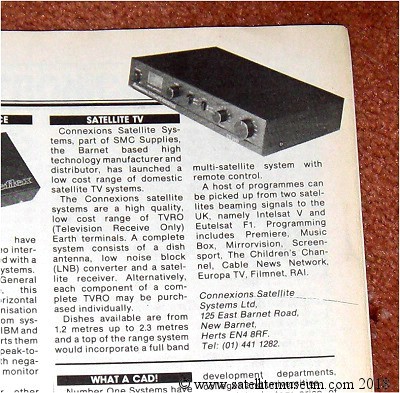
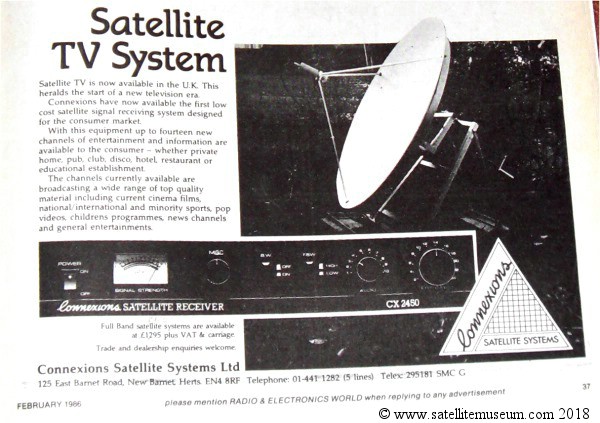
1985. The Connexions CX2450 & CX2460.
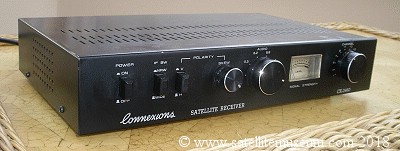
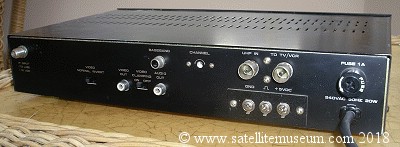
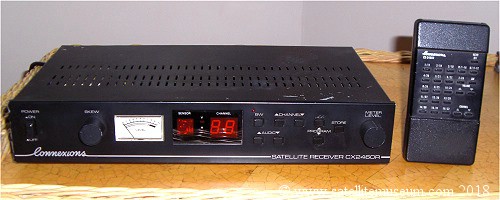
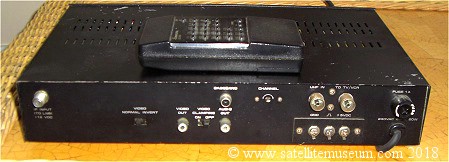
Connexions became a very well known make in the late 1980s and early 1990s.
They often had full page adverts in the satellite magazines and they produced a very good range of
quality satellite receivers including motorised receivers. We are very please to have both models of connexions
receivers from 1985 - the CX2450 and the CX2460. The CX2460 was a little more up-market and expensive
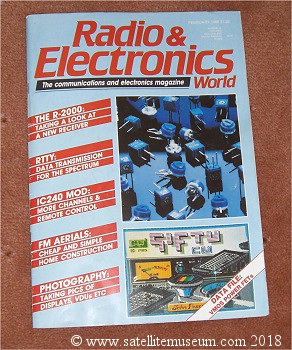
as it included a remote control and a channel number display. A magazine "Radio & Electronics World" from
Feb. 1986 details a news article about both models and a Connexions advert. 1985 was really the start of
direct to home broadcasts. These receivers must be considered as the first of several
satellite receivers ever to be sold specifically for domestic use.
 Receiver memory lane ...
The Echostar receivers SR-4500 and SR5500 were quite common when I started in the satellite industry .....
Echostar SR-1000.
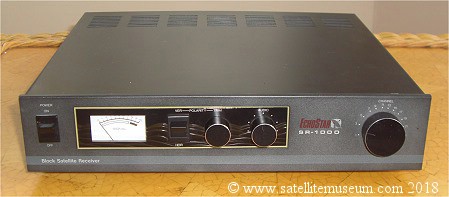
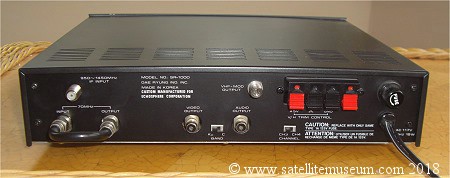
This early Echostar receiver is a basic stand alone receiver with knobs on for fixed dish use. The probable date is 1985.
Echostar SR-4500
One of the 1st ever integrated motorised receiver.
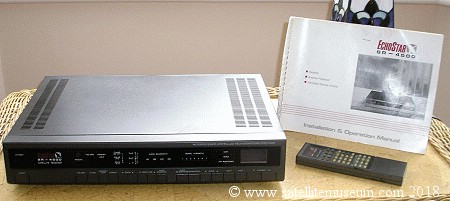
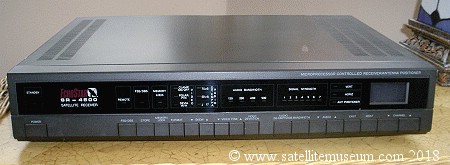
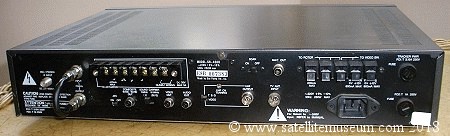
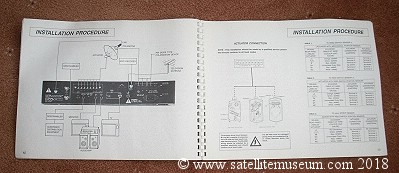
The SR-4500 in the museum was manufactured in 1987. This model was first introduced in 1986/87 and
was made until the SR-5500 replaced it. The SR-5500 was introduced 1988/89.
The museum unit is in very good condition and comes complete with handset, manual and leads. In the
original collection going back many years we also have an SR-4500 handset, so we now have two handsets.
2007 Update
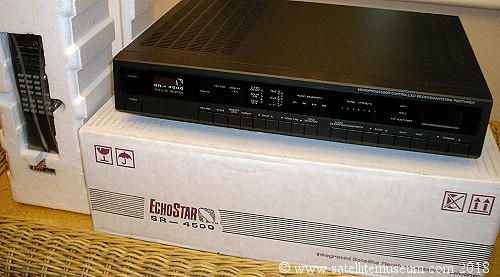
Even back in 1989 / 90 there were only old SR4500s to be seen. Incredibly in Dec. 2007 the museum acquired a brand
new and boxed SR-4500 complete with handset and manufacturers packaging. This was an unbelievable find and is a
valued addition to the vintage satellite collection.
Echostar SR-3500.
One of the 1st ever integrated motorised receiver.
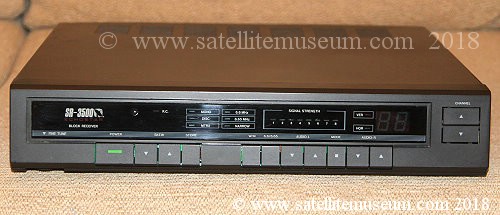
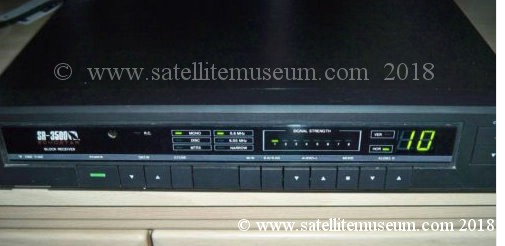
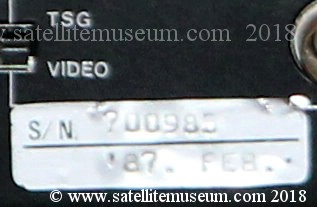
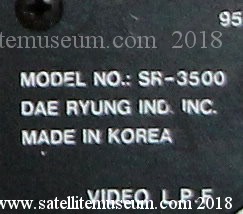
The Echostar SR-3500 is a very rare satellite receiver.
I have seen many SR-5500 and SR-4500 receivers in the late 1980s and early 1990s but I had only ever seen one SR-3500
until now. I used to own an SR-3500 after it was given to me during a customer upgrade in those days and unusually
for me, about 15 years ago, I disposed of it. I did, however, keep the handset (so I was not entirely unstable at
the time!). Recently I was able to find another one without a handset so it is good job I kept the old handset.
This one has Feb. 1987 on the serial plate on the back. This leaves us with two mysteries.
1. The SR-3500 should have been an earlier model than the SR-4500 and I would have expected an earlier date of 1985
or 1986. Maybe there was some overlap in their manufacturer and this was one of the last ones made.
2. My recollection of the SR-3500 I originally owned was that it was not motorised and only had polariser controls on
the back. I am pretty sure that is the reason I did not keep it, not motorised and no knobs on it. I did not realise how
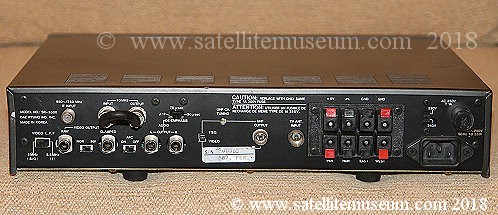
early a model it was at the time. This one, however, has full motorised dish connections on the back. Is my memory
incorrect or did they make two models, one with and one without the 36 volt motor connections? Anyway I am very
pleased to find another one to correct my moment of unusual madness when I did not keep something. Very unusual
for me to do that. This SR-3500 came into the museum in Feb. 2018. If anyone knows if the SR-3500 was available
without the motorised option, maybe you could send me an email from the contacts page on the web site.
On the back of this receiver is the name "Dae Ryung Ind., Inc. Made in Korea". This is interesting as it suggests
this is the manufacturer who built this receiver for Echostar. Research shows that this manufacturer started in 1982
and manufactured telecommunications equipment including satellite receivers. Their factory is in Seoul, South Korea.
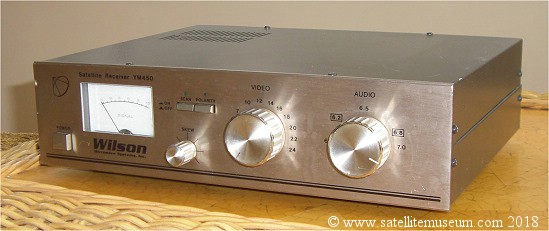
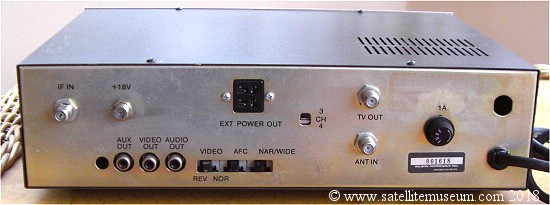
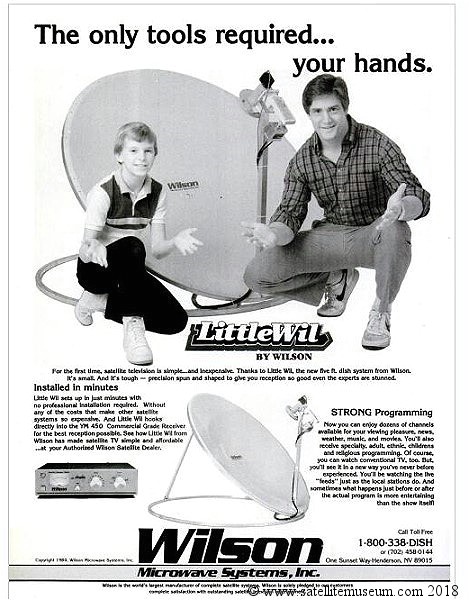
1985. Wilson YM 450 satellite receiver.
This is another very early satellite receiver. The adverts below are from Sept 1985 and so this receiver must have
been available from the spring or summer of 1985. This is a US product. There is no evidence it was ever marketed
in Europe. The advert is interesting as it shows a feedhorn, mechanical polariser, a prime focus dish and a patio
mount. The theme of the advert is of an "easy, do it yourself installation". As with many companies from
that era, there is no evidence that this company still exists.
 1985. Anderson Scientific ST1010.
This satellite receiver is in mint condition. It was introduced in the USA in 1985.
Inventor - Keith V Anderson, Black Hawk, South Dakota
The US patent information for this receiver (filed Dec. 7th 1983) would appear to be at
https://www.freepatentsonline.com/4608538.pdf
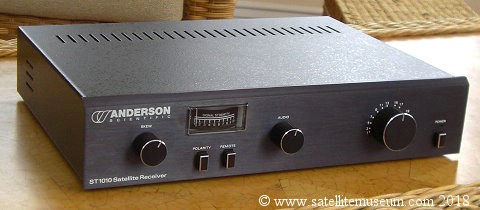
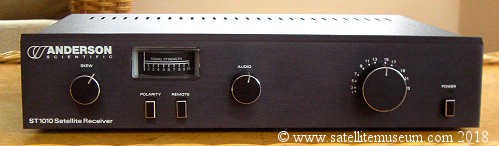
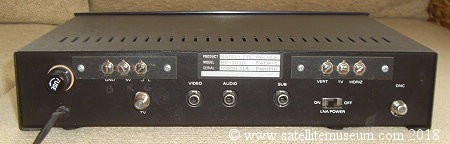
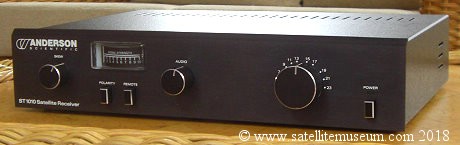
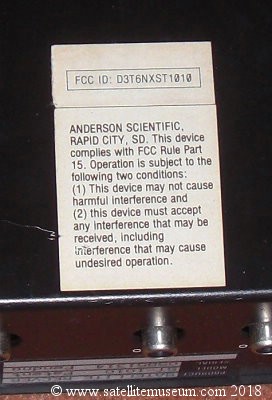
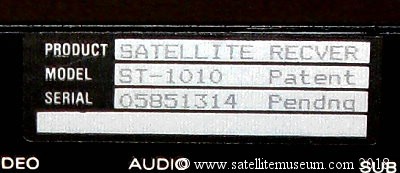
When a serial number starts 0585 ... could it mean May 1985?
Keith Anderson was a pioneer designer of early satellite TV and he is featured in our
History of Satellite
TV
"1985". Uniden UST-1000.
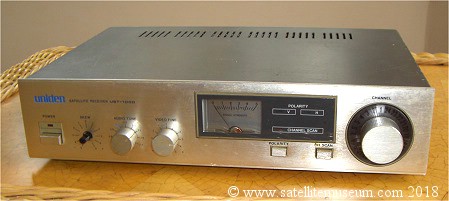
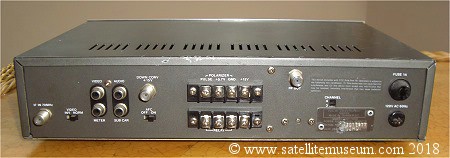
Uniden are one of few companies who there at the start of domestic satellite TV and they are still in business today.
From the
Uniden website - www.uniden.co.jp it was clear in 2010 that Uniden started making
satellite
receivers
in 1984. This information is no longer in the history section of their web site. The Uniden UST-7007 (below)
is from 1987. That information would help date the UST-1000 as between 1984 and 1986. Probably 1985.
1987
Early Drake satellite receivers.
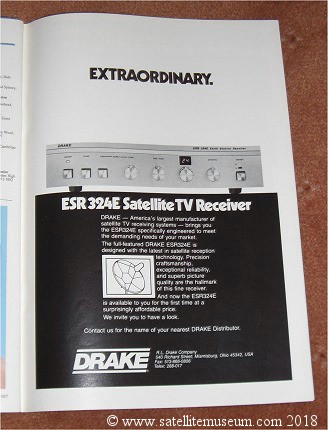
1987. The Drake 320E satellite receiver
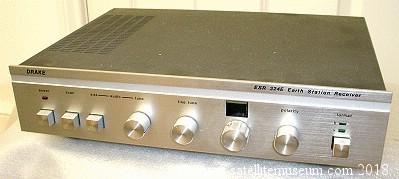
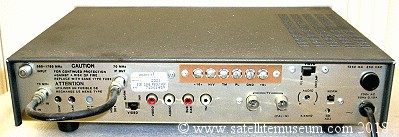
In the UK, Drake was distributed by Alston-Barry International (originally Alston-Barry Satellite Services)
from the Mid 1980s to 2000 approx.
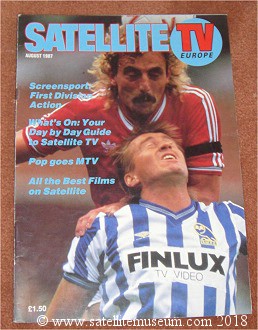
Below we can see the Drake ESR320E in an advert from "Satellite TV Europe" dated August 1987.
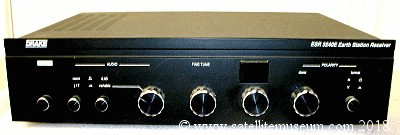
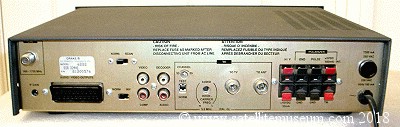
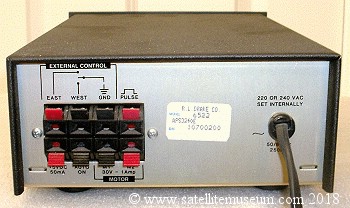
 The Drake ESR3240 satellite receiver with
Drake APS3240E 36-volt positioner.
 The Drake ESR240 and ESR 24
satellite receivers
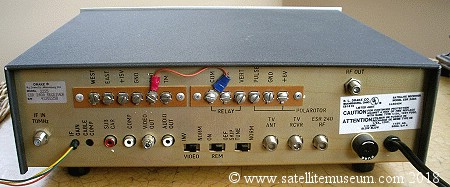
The ESR 240 is another great receiver with knobs on AND large meters.
Clearly from the early to mid 1980s. In it's day this would have been a top of the range satellite receiver.
This unit was added to our collection in April 2007.
It is arguably the best looking "knobs on" receiver we have.
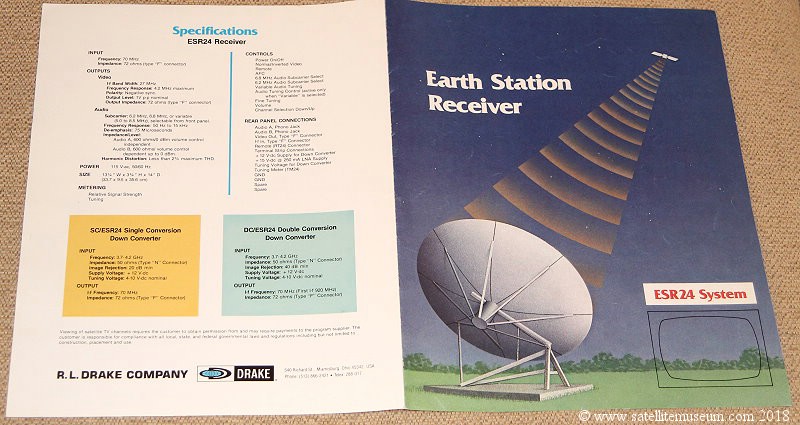
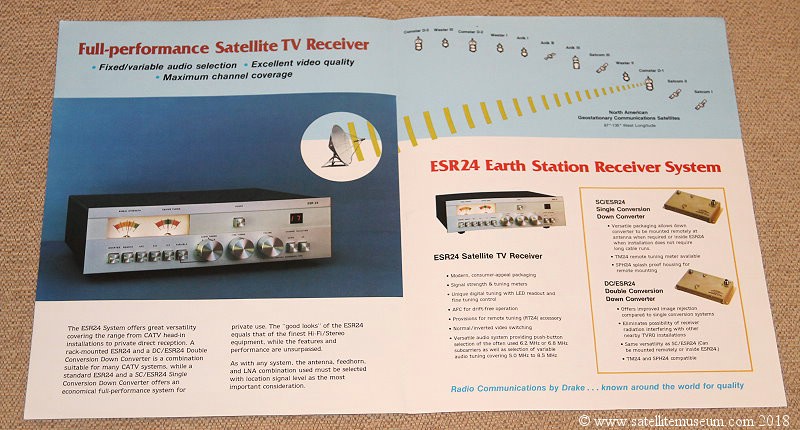
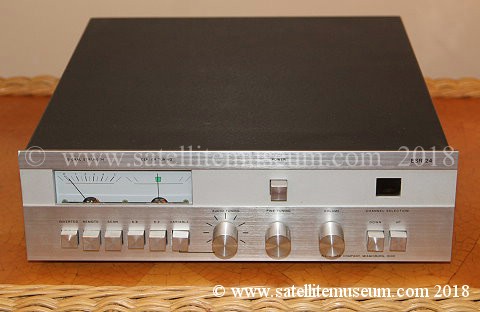
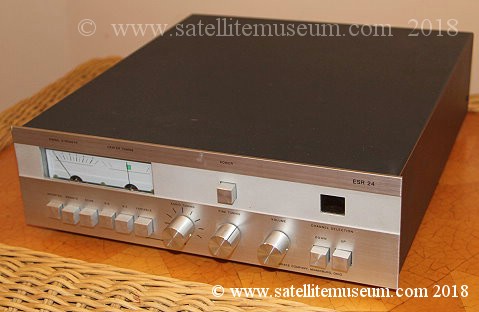
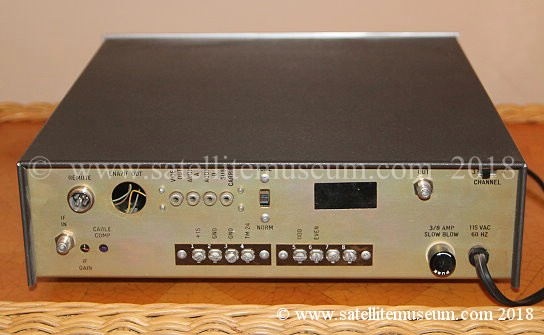
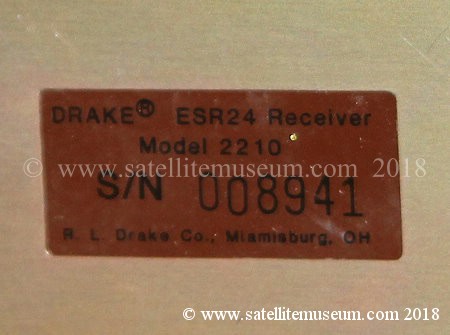
The Drake ESR24 brochure and the ESR24 is shown below. It is very similar to the esr240 (above) but
the power switch is in a different place and some other small differences.
The brochure was added to the museum in 2011 and the esr24 in 2018
From the company history page on the Drake web site at
https://www.rldrake.com,
"Drake expanded their product line with marine radios and other reception hardware. In 1981, Drake investigated the then
semi-hobbyist field of home satellite reception equipment. Drake engineers, under the leadership of founder's son
Peter Drake, completed a prototype satellite receiver in just four months."
Drake was founded in 1943. From 1957 they built shortwave radios for the radio ham enthusiasts.
Drake is one of the very few founder satellite companies that still exists today.
When I started in satellite TV in 1989 I remember seeing the Drake ESR3240 / APS3240E in customers homes.
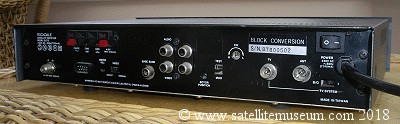
1987. The Rockdale TR12E & SLC-7
The Rockdale TR12E receiver with AP100 36V positioner (on top of it)
and (below) the Rockdale SLC-7 satellite receiver.
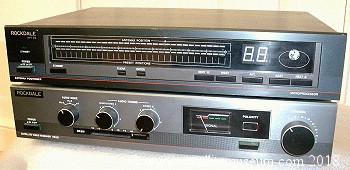
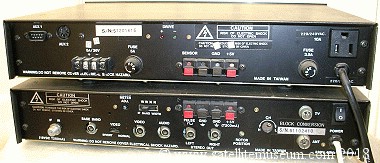
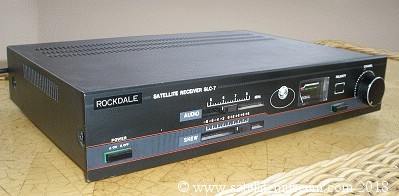
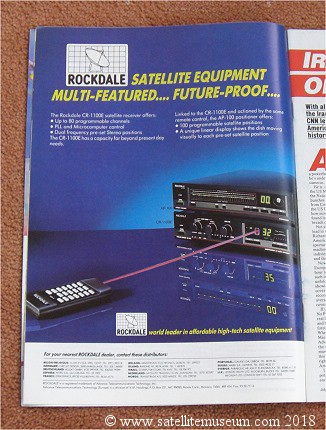
The Rockdale TR12E was knobs on without remote control version of the CR-1100 receiver shown in the advert below.
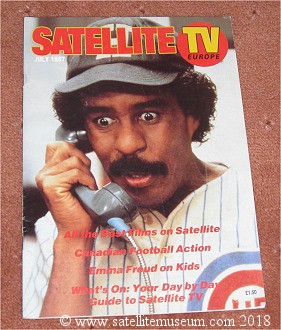
This advert is from the July 1987 Satellite TV Europe magazine which also features the Rockdale AP100 matching 36 volt
positioner. The SLC-7 satellite receiver also had remote control capability and could be used with the AP100 positioner.
 1987. The Uniden UST-7007 receiver
with UST-771 positioner.
Motorised receiver kit. 36 volt positioning.
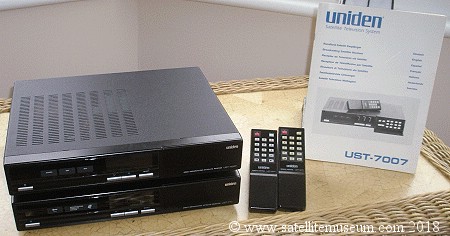
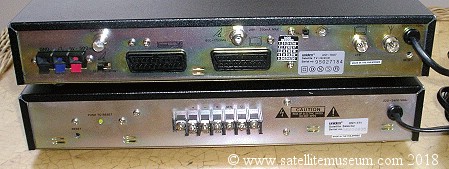
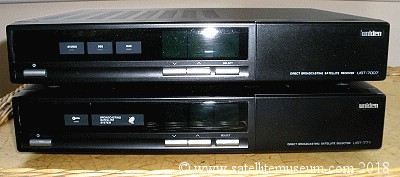
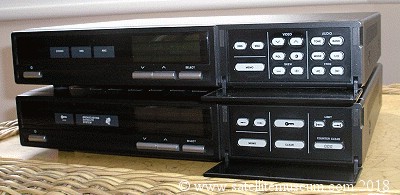
This was a popular motorised receiver kit in the mid to late 1980s. This kit is complete with 7007
manual and both handsets and is in excellent condition. As stated elsewhere on this page, I started
in the satellite industry in 1989 and so these units were a little "before my time". They were not
being sold new at that time but they were reasonably popular in peoples homes. Putting that last
statement into context, popular with the people who had motorised systems which even today is a
minority situation. These Uniden units were classed as good quality units from a manufacturer known
for quality products. Maybe not top of the range flagship units but certainly mid priced good quality
units. Indeed, the 36 volt positioner unit is as good, if not better, than any available today and
probably better built than any of them. The receiver (indeed, all early receivers) became out of
date within a few years as it only had a 1750MHz tuner. (Modern LNBs need a 2GHz tuner). Many people,
however, continued using their 771 positioner with more modern receivers. It was really only when
the Echostar 5500 came out in 1989 (approx.) that this unit started to look dated and when the
Chaparral Monterey came out the same year (1989) - everything took second place to a Monterey.
When I started in satellite TV in 1989 I regularily saw Uniden UST-7007 receivers in customers homes.
A very early Uniden satellite, the
UST-1000, a receiver with knobs on and a VU meter is shown higher up the page.
1987. Discus Elipse motorised receiver
This was an inexpensive motorised satellite receiver.
An integrated receiver positioner - 36 volt positioning.
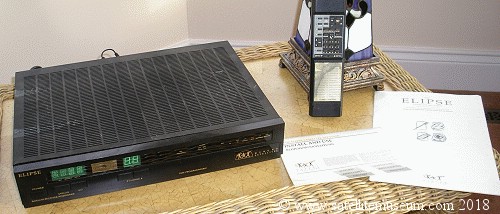
The manual says - "Design and production by The Communications Factory Dundee, Scotland." "Discus Satellites Ltd."
And on the receiver - "Made in Scotland."
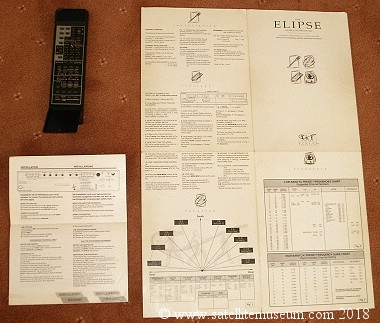
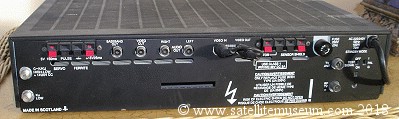
In 1989/90 I new about this Scottish receiver and it was very cheap (less than £200) for all the features
it had, remember this was an integrated receiver positioner. However, it was a receiver that I made a
conscious effort to avoid and the reason was that it was complicated to set up and complicated to use.
Other receivers on the market may have been more expensive but they avoided all the problems of customers
"tearing their hair out" and complaining! It does, however deserve it's place in the history of this type
of receiver. I remember seeing it in customers homes and having to deal with it.
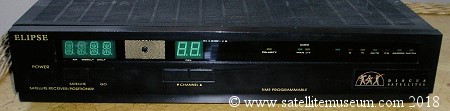
Modern motorised digital receivers with blind search can easily exceed 8000 channels after a full scan.
Here is a quote from the Discus Elipse "Install and Use" manual,
"Thank you for selecting the Elispse Satellite Receiver. You now own a window to the world with
access to 184 channels of satellite television viewing - present and future."
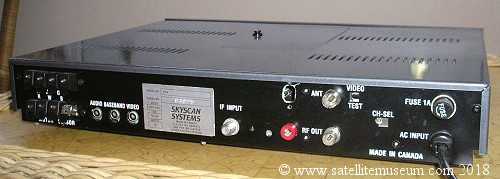
1987. Skyscan Systems K1A receiver.
A motorised satellite receiver from 1987.
One of the first domestic integrated motorised positioner
satellite receivers - 36 volt positioning.
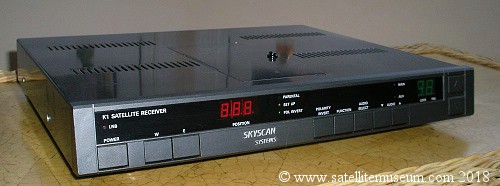
Details on the back of the receiver say "Made in Canada"
When you check out the US patent on this receiver it refers to "AED Satellite Systems, Ltd" in Montreal
Canada. That all seems to check out and agree with the description of this product. If so, the US patent
was filed in 1984 and issued in 1985. That being the case, a manufacturing estimated date on 1987 would
not be unreasonable and would tie in with other similar products and dates above. Also the advert below
now confirms 1987. In addition, from online patents research, the inventors in Montreal Canada hold
several patents from 1975 to 1980 and the Assignee was AED Satellite Systems, Ltd in Montreal Canada.
This is another receiver that had a good following at the time. Again just a couple of years
before I started but they were in customers homes when repairs or upgrades were being dealt with.
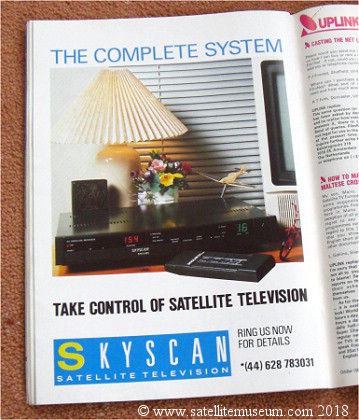
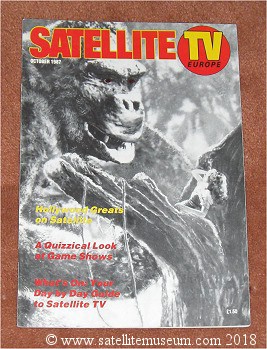
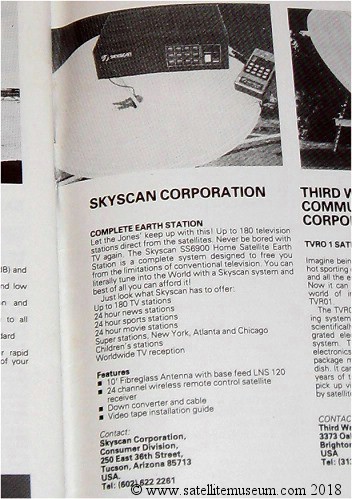
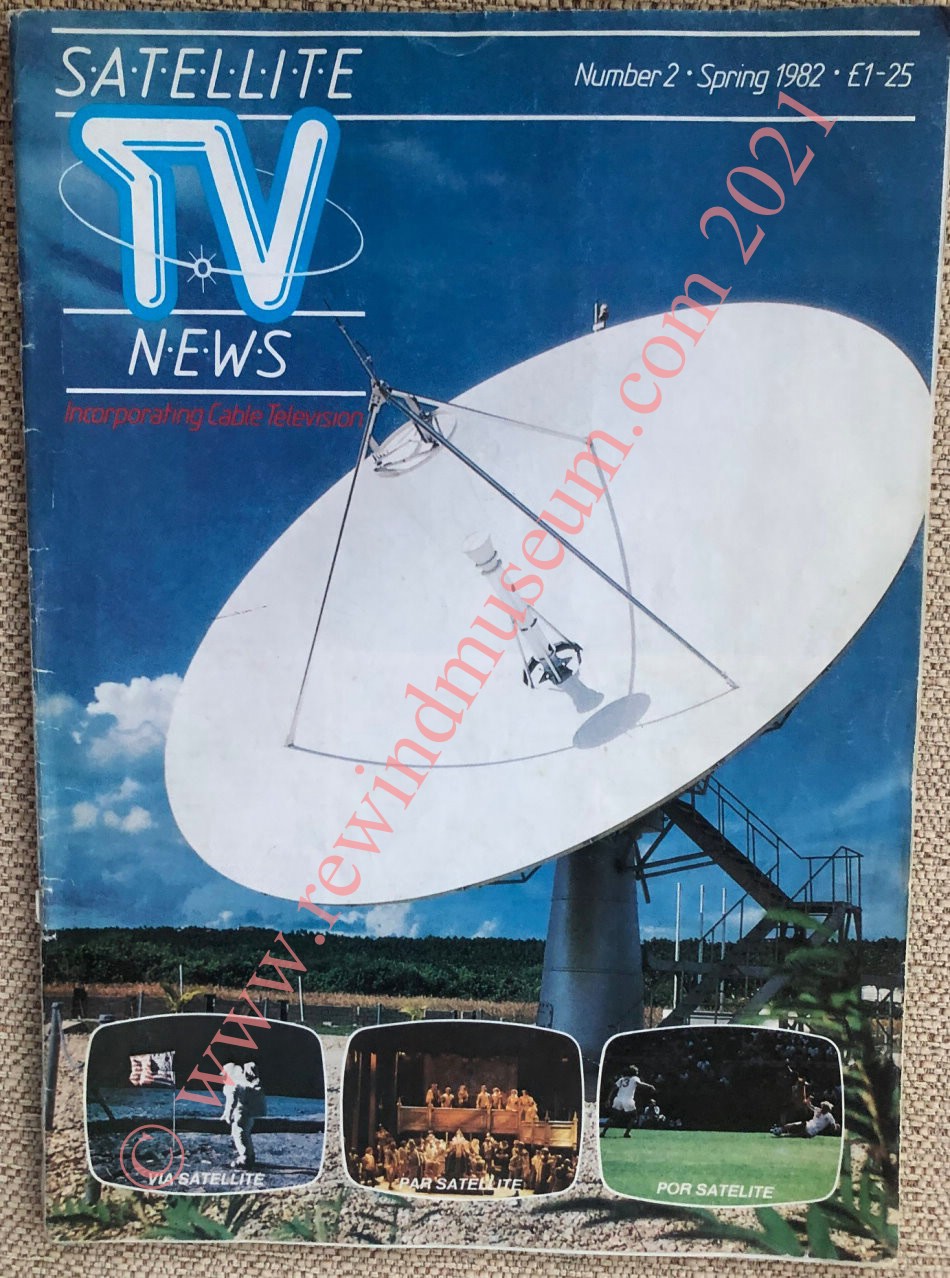
We also have a "Skyscan" advert from 1982 from the spring issue of "Satellite TV News" but it
is not clear whether this is the same company. It should be noted that in 1982 there were a few
satellites above the USA transmitting TV programs which could be received on 3m (10') dishes.
Skyscan Satellite Systems and Skyscan Corporation may or may not have been the same company.
 The Satcom 7700 satellite receiver
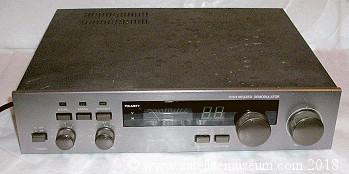
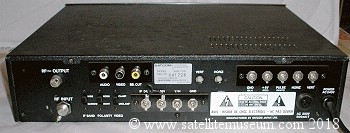
This receiver has been in the collection for very many years and yet we have no information about this item.
It would have dated from around 1985 to 1987.
The Satcom 7700 has some sentimental value as I think it was the 1st "knobs on" receiver ever to be part of our collection.
1989
1989. The Bennetts 2026L
satellite receiver mystery
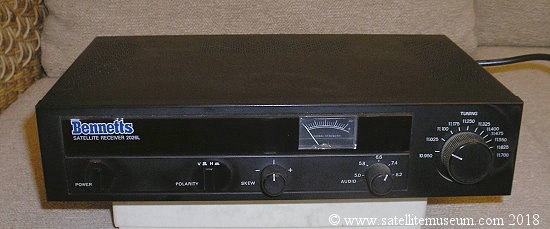
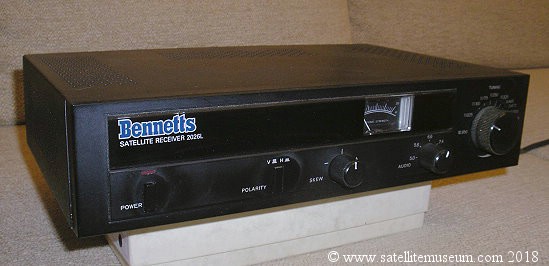
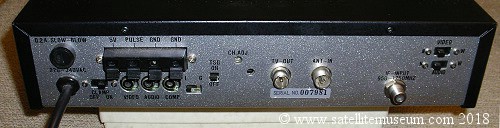
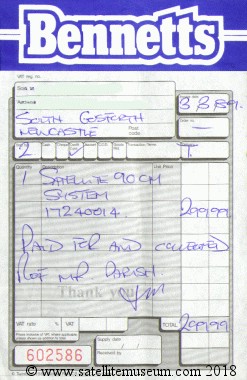
Bennetts was a large department store on Shields Road, Newcastle (with a head office on Kings Street, Norwich. UK)
Clearly this receiver must have been sourced and badged. That is quite a common practice these days by large
satellite distribution companies but for a general retailer store to do that in 1989 is interesting. The receiver
has some original warning stickers underneath that are in French and these would indicate that was the country of
origin. It was purchased in 1989 with a 90cm fixed dish for £299.99 - this was expensive in those days. It was used
on the Astra satellite at 19E. In 1989 this satellite required a 90cm dish as it was not as powerful as it is now.
The controls are interesting. Signal strength meters were quite common. A manual polarity switch! and variable skew
using a knob on the front. If anyone knows any more about a receiver with model number 2026L and probably
manufactured in France please let us know. The Receipt is dated the 3rd March 1989.
Sold at the beginning of March 89, this model may have been available from 1988
The story does not finish here, read about the Zeta-1000L below and the Feb 2007 update.
The Zeta-1000L satellite receiver.
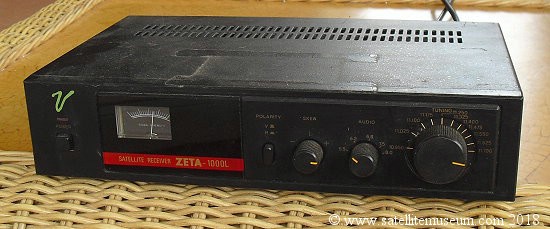
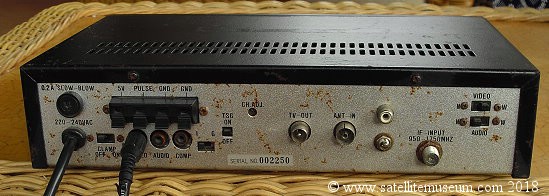
A little more light now shines on the Bennett 2026L receiver mystery above. This Zeta-1000L receiver is exactly the
same. It would appear that the Bennetts receiver is a clone of the Zeta receiver. It is also possible that they are
both clones but the Zeta receiver also came from a local supplier in North East England. It originated from a well
known distributor called "Network Communications" from Hartlepool. (Our company used to purchase goods from Network
Communications.) This satellite distributor disappeared in the mid 1990s but a local installer here in the north east
purchased it from them at the time and eventually donated it to the museum. It was purchased in the late 1980s and
for many years was used in a local pub. The installer supplied it to the pub and again many years later when the pub
upgraded he took it home. This additional information is useful but we would still like to know more about the
origins of this unit. From the serial number - 002250 if may have been earlier than the Bennetts receiver with a
serial number of 007981. There is also a small difference in the connections on the back with additional sockets
on the Zeta-1000L Network communications also produced their own range of prime focus satellite dishes.
Update Feb 2011
It seems there was a matching dish positioner for the Zeta-1000L. It was called a Zeta-7000 positioner.
Also from an email we recently received -
"My observations about the production and serial numbers are as follows.. The first batch of Zeta's were model 1000
and had serial numbers less than 1000. The second batch were Zeta model 1000L and had serial numbers in the 2000's
The third batch were also 1000L's but serial numbers jumped up to above 5000. The five I have right now are numbers
2258, 2480, 5405, 5466 and 5751 The three different productions can be internally identified by three different main
printed circuit boards. The first PCB had only two voltage regulators on the PCB and the later second and third had
four, but their are more subtle differences on the PCB layout between the 2nd and 3rd productions. All units I saw
with 2000 serial numbers had black meters and all 5000 serial numbers had yellow meters. The lids on the 5000's had
extra holes in the top and sides to aid cooling these were round holes instead of the earlier slotted holes in the
top only on models with 2000 serial numbers. I have seen several Bennett branded units but none are in my possession
right now. I remember them as having PCB's like the Zeta second and third production models. A friend has a Zeta 1000
out of the first production unit serial 000070 he also has Galaxy 2022L s/n 9466 and Susumu 2026L s/n 4324 both
have "Zeta" PCB's inside."
Note the serial number of the Zeta 1000L in the museum is 2050
Feb. 1989 Triax Triasat 2000S
with positioner.
Motorised receiver kit. 36 volt positioning.
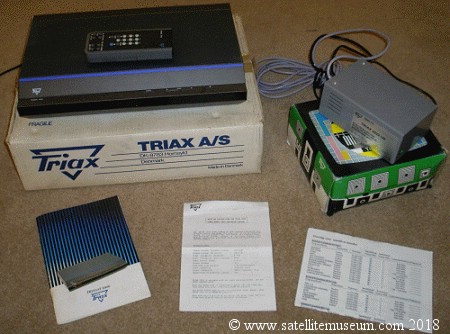
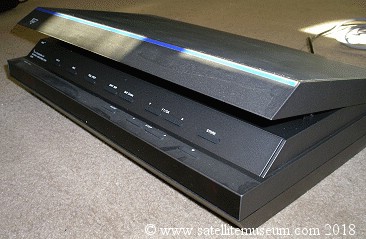
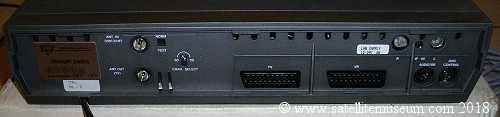
This kit is complete with positioner, manual, handset and original boxes and is in excellent condition.
This is not a unit that I have ever seen before but it is clearly dated in the manual at Feb. 1989.
It has some interesting features. The unit looks very modern and has concealed controls under a
unique hinged up lid. The positioner module looks like the types of units used in the very early 1980s
and resembles a power supply rather than a piece of domestic AV equipment. The positioner is connected
to the receiver by a control cable and so everything is electronically integrated and controlled by
one handset. The handset is large, as most were at the time. The manual shows that the receiver was part
of a complete satellite system including a Triax prime focus dish and using a mechanical polariser.
Prime focus dishes were the norm until the mid. 1990s.
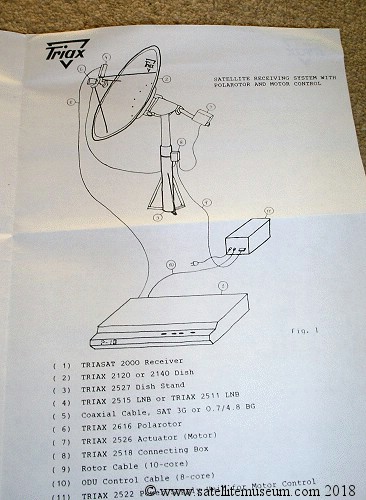
Once again is very pleasing to have a complete boxed kit. Triax is a company that manufactures a very wide range of
products today. Whilst most manufacturers of historic products on this page have long since disappeared, it is
good to include an old receiver from a manufacturer who is still a market leader today.
1989 Bang & Olufson Beosatrx
receiver with 36v positioner.
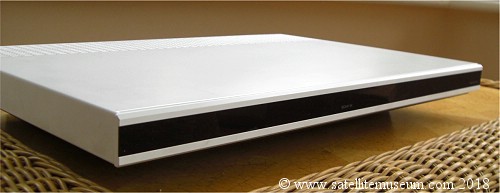
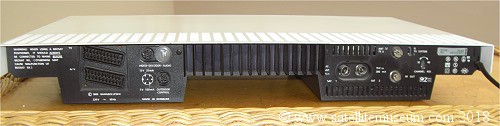
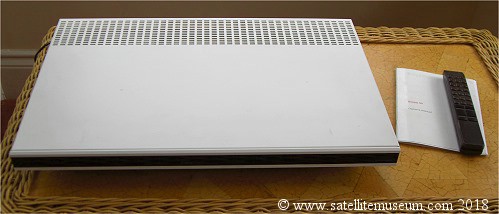
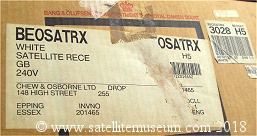
There have always been attempts to produce satellite receivers which are stylish to look at. A very interesting and
notable attempt was made by Bang and Olufsen in 1989 : the Beosat receiver. Many will remember the way B & O
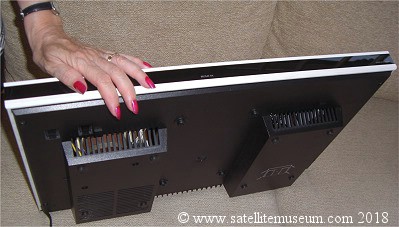
produced very slim stylish CRT televisions but on closer inspection of the rear of the set, it was an optical
illusion. The tube still stuck out of the back just as far, it was simply that the sides you could see were narrow.
The 1989 Beosat used the same visual trickery. It looked like a very slim unit but on closer inspection the case
is actually much bigger. The base and feet hide the depth and the width and depth make it quite large.
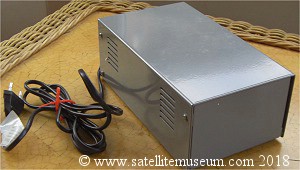
This receiver also had an option of motor control and could be a full motorised receiver. This involved a
connection lead to a separate box. From the picture of this add-on box it is clear it needed to be hidden
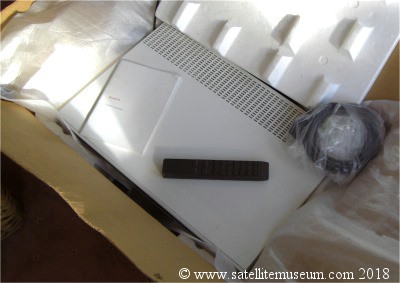
away out of sight. We are pleased to have a complete kit in the manufacturers packaging.
1989/90. The PDS Ltd. Rainbow
12 volt receiver. 1989/90 approx.
Possibly the first ever 12-volt receiver aimed at the caravan / leisure market.
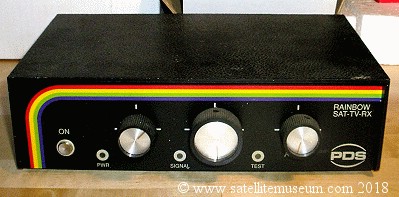
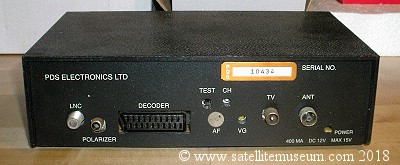
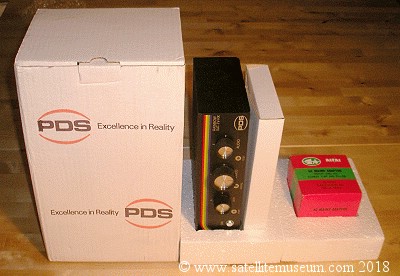
This unit was available new when I started in the satellite industry and therefore can be dated
around 1989 - 1991 approx. Research tells us that the PDS Electronics Ltd. company was
dissolved in 1995 and I don't remember any other product which they made although there
could have been. This analogue receiver is very light weight and has knobs on. Even in
1990 knobs were a little unusual and were a throw back to the mid 1980s but being a
simple to use unit for the mobile leisure market, it was meant to be no frills and simple
to use. This unit in the museum was owned by me from new although it was bought in as a
sample and like many things over the years was stored as a possible future museum item.
In those days on-line museums were not even dreamt of but I always felt somehow when
I saved something and put it away, perfect in it's original packaging, that it would be a
consumer electronics antique in the future.
If anyone has any more information on this product, please let us know.
Update Feb. 2011 - email - Some information on "PDS" -
"PDS were a prolific manufacturer of "pirate" decoders for the Dutch film channels 'Filmnet' and 'RTL'
in the 1980s and early 1990s from Astra 1 at 19 east. They made a decoder called a "Combi-99".
The decoders were available fairly cheaply at about £40.00 with scart in and out and a
row of dip switches to set baseband, video, etc. When Filmnet was encryption (LEDs lit up!)
the "Combi-99" would unscramble the film into reasonable quality pictures. Filmnet, however, were
not too happy about the availability of cheap decoders and every 2 weeks or so would change the
encryption routine - PDS customers would then have to send the decoder back to PDS for
adjustment and return, then lose pictures again only a few weeks later."
"PDS also made an unusual item called a 'sync inserter'. This was of interest to Sat-zappers as
the news feeds over the EBU circuits on 7 east used sound in syncs [SIS], a form of early digital
transmission when the audio was digitised and inserted with portions of the picture syncs thus saving
the cost of leasing both video and audio circuits. This was first used by the BBC for terrestrial network
links across the UK. The problem was that any audio modulation resulted in the pictures shaking.
The sync inserter provided the enthusiast the means of inserting his own locally generated syncs
and removing the picture shake. So you enjoyed stable pictures but with no sound. These things
were critical to set, mine was returned for repair and PDS went bust whilst the sync
inserter was with them and it was never seen again."
This page will soon also contain -
Pace BSB receiver in original packaging. (In storage - will be added to the site later)
Toshiba BSB receiver in original packaging. (In storage - will be added to the site later)
RSD 300 satellite receiver (see blind search notes below)
The Echostar SR-50
A very early analogue satellite receiver with knobs on.
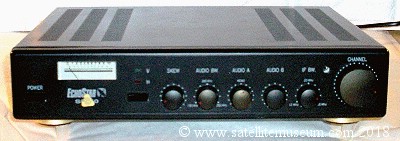
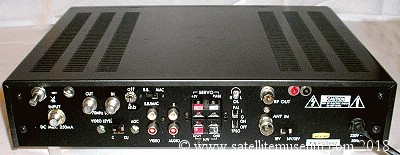
When I started in the Satellite Industry back in 1989, the experts in the industry at the time
proclaimed the Echostar 5500 (which was available new in the shops in those days) as the best
motorised satellite receiver in the world. It was fairly short lived as at about that time the
Chaparral Monterey (see below) came out and then (in my opinion and many others) took the top
spot for the next 10 years as it was continuously developed and improved by SCT. However,
during that time Echostar introduced the 6500, the 7700, and then the 8700 analogue receivers.
After that came the 3000 analogue and digital receiver, the 3600 analogue and digital receiver,
and the 7000PVR. (Basically a 3600 with a hard drive.) By the time the 3000 came out the Monterey
had finished it's run at the top and the last three analogue and digital Echostar receiver
mentioned were then each proclaimed as being the best motorised receiver available at the time.
Not that the earlier analogue receivers were not good. They were excellent but they were also
much cheaper than the Monterey. A typical price being under £500 (e.g. the 8700) whereas
top-of-the-range late Monterey was as much as £2500 9just the receiver!) We are, however, getting
a little ahead of ourselves (literally) as we need to go backwards in time not forwards. Before
the 5500 back in 1989 was the Echostar 4500 and before that the 3500. In those days, I saw these
in customers homes when they were upgraded to an Echostar 5500 or Monterey and so although they
were "before my time in satellite", I did see them in the second hand area. The 5500 was a very
good receiver but I was not at all impressed with the earlier 4500 or 3500 as they had complicated
menus and were difficult to use and set up. Everything mentioned so far was controlled by a
handset remote control and my guess is that the Echostar 3500 could have been 4/5 years earlier
than the 5500 of 1989. (i.e. early to mid 80s) So what about the SR-50 with knobs on? Was it earlier
or could it have been around at the same time as the 3500 to 5500? (I know it was available for
a number of years). It was not a motorised receiver. It had no internal positioner. It had knobs
on the front. It was considered to be a good enthusiasts receiver due to it's excellent
specifications (for the time) and the fact it had very good adjustable controls for the "DXer".
and feed hunter. The SR50 was avaialable new through the mid 1990s and even a bit later. This was
strange as it it looked very dated (receivers with knobs on had gone by 1990), however, Echostar
aimed the product at the satellite enthusiast market.
This Echostar SR-50 has been donated to the museum by Roy Carmon a well respected feed hunter
writer and satellite enthusiast.
Update Feb 2011 -
The EchoStar SR-50: it was produced in 1992. Not earlier. Its main selling feature was its very
low threshold -- this is the measure of the ability to pick up weak satellite signals and deliver
a watchable picture while other receivers just deliver snow on the screen. The SR-50 was much loved
by DXers in Europe and the UK but in fact the main intended market was Africa and the Mid East where
people were able to receive unintended sidelobes off Astra 1a.
For reference, while in the UK and Europe the SR-4500 was indeed replaced by the
SR-5500, 6500, 7700, 8700, etc., the SR-4500 had its greatest success south of the Sahara.
As noted above the reason was that it had a very low threshold and so it was sensitive enough
for people as far south as Lagos, Nigeria, Harare in Zimbabwe, and even Jo'burg to be able to
pick up a few Ku channels off Astra 1a. These sales in Africa were very strong during the early
1990s and EchoStar introduced the SR-50 to strengthen its hold on those markets.
Please note that we are looking for an Echostar 3500 for the museum.
The SCT (Chaparral) Monterey.
The most upgradable and upgraded (and probably the best)
motorised satellite receiver in the world for 10 years.
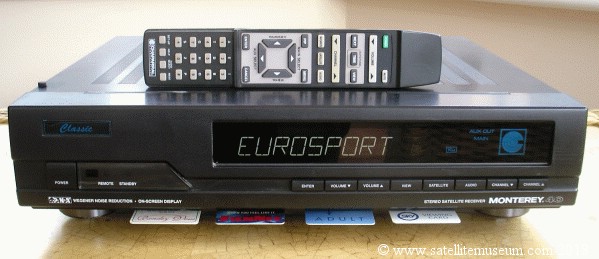
For 10 years (1990 to 2000) the Monterey was the best satellite receiver in the world. Many more pictures
are to follow when the museum's Montereys come out of storage. (We have 4 of these units in storage.)
Later models were both analogue and digital. Our parent company sold the Monterey for all of the 10 years.
Our company was an authorised Monterey repair and upgrade centre. The Monterey was the most upgraded
satellite receiver of all time. Over the 10 year period it received countless software upgrades. The
first software had only 100 channel locations. Later software was 5000+ On the hardware side it had
the following upgrades, Videocrypt decoder, D2MAC decoder, Videocrypt and D2MAC decoder and 4 card
reader, low threshold board and sync inserter for low signals and better sensitivity, 2GHz tuner and
tone inserter for universal LNBs, integrated digital board with very crude blind search. (Not really
designed for blind search, more a by products of the chip design which gave it auto FEC and symbol
rate and some crude blind search qualities.) All this in the late 1990s! Another first and even now,
never equalled or beaten, the Monterey had the largest alpha-numeric display ever fitted to any
satellite receiver. Earlier models without the display could be upgraded. Even an 8 card reader
(two stacked 4 card readers) was available and can be seen in the picture above.
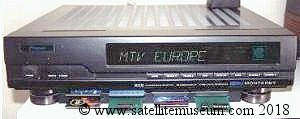
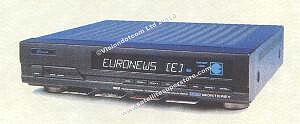
The Monterey was manufactured by Chaparral Industries in California but Steve Chilver
in the UK was, at the time, was a consultant engineer for Chaparral. He then became the
authorised importer forming his own business SCT Ltd. and he then designed, developed
and manufactured all of the software and hardware enhancements which made the Monterey
the worlds best motorised satellite receiver. The SCT Monterey also takes the title
"the most expensive consumer receiver of all time." Models started at £1000 and went
up to £2500 depending on how many features and hardware upgrades were added.
There were plenty of takers even at these high prices which sharply contrasts
with the situation today where customers think receivers at £300 are expensive.
We have 4 Monterey’s in the museum. One of them is complete with all
manufacturers packaging and in perfect condition.
The "What Satellite Magazine"
supplement - World Satellite Finder.
This supplement eventually led to this web site!
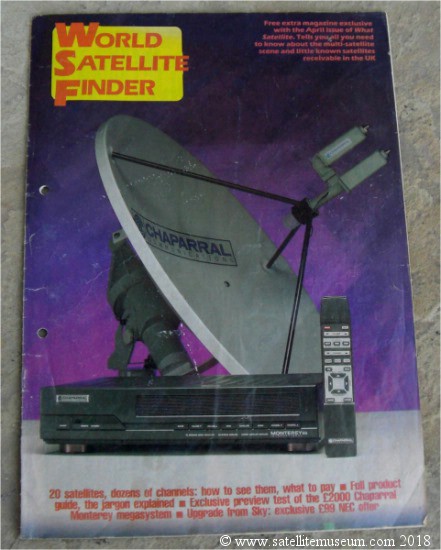
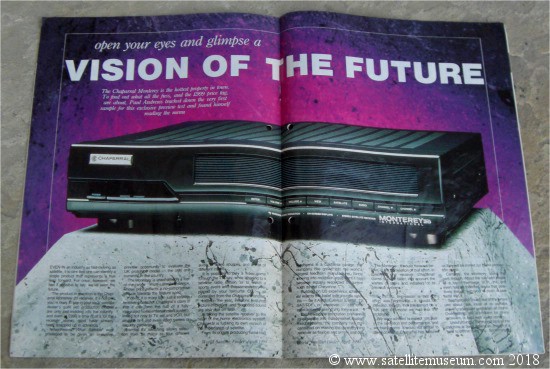
This supplement was published in a "What Satellite Magazine" in 1989. After reading this supplement I purchased
a Monterey from a trade outlet called "Micro X" and a motorised satellite system was installed. At the time we
were installing satellite TV through our video production business. About a year later our dedicated satellite
business was started and the company became an Authorised Chaparral / SCT dealer for the Monterey receiver.
Our first satellite website started in Feb. 1998 and
www.satellitesuperstore.com stated in April 2000
This eventually led to the
www.rewindmuseum.com museum web site in April 2004 with a vintage
satellite page. In October 2009 this dedicated
www.satellitemuseum.com web site was introduced.
This "Vision Of The Future" supplement was a major inspiration to me and was a large factor in me starting
the satellite TV business which eventually led to this satellite museum.

The History of Motorized Satellite Receivers.
1980 to the present.
Fully integrated receiver (36 volt) positioner motorised receivers.
The main, most consistent manufacturer over 20+ years was Echostar.
Echostar motorized analogue receivers - 4500, 5500, 6500, 7700, 8700.
Echostar motorized analogue and digital receivers - 3000, 3600, 7000 (see the 7000 below).
(there were also some digital only models which ran alongside the analogue and digital models,
but the latter were classed as the most up-market.)
The Echostar SR- 4500 was one of the first ever analogue receiver with built in 36 volt positioner,
single input to receive both C & KU band satellite channels in 1985. It was before my time
(pre-1989) but I did see them in customers houses when they were upgrading. For the
first time it was possible to move the dish and select channels on the one handset.
More about the SR-4500 is detailed above where our museum exhibit is featured.
The Echostar SR-5500 was the main motorized receiver available back in 1989
and they were sold in large numbers. They were a very good easy to use receiver.
I attended a motorized training session in 1989 run by Eurosat. The lecture was
being given by a company called Pro-com who made a very high quality dish (unfortunately
the company went out of business about 5 years later) but the MD who was giving the lecture
was using a new Echostar 5500 which he referred to as being the "best receiver in the world."
At the time I thought that he was a little out of date as the Chaparral Monterey had recently
been introduced. The future proof, upgradable Monterey ruled the skies for the next
10 years. That being said the Echostar 5500 was very good in it’s day. The 6500 had
reliability problems but the Echostar 7700 and 8700 (1994) were both excellent. They
were a good alternative to the Monterey as they were much cheaper. There were some
other receivers (not so up-market) which came out during this time scale including a
very complicated to use Discus Elipse (that most dealer / installers avoided like the
plague – it had two things going for it. It looked good and it was cheap but it was
a nightmare to use and set up.) and the excellent Pace 500/508 (1995) (not expensive
but the channels were not grouped in satellites – just one long list – apart from that,
very good and very easy to set up.) Another very good motorised receiver was
the Drake 2000 (and the cheaper Drake 800) which was similar to the Echostar 8700.
When digital started the Monterey received a free to air digital option (1998/99) which
was the only Monterey upgrade that was troublesome. This was a first but it was not really
a fully integrated analogue and digital 36 volt motorised receiver, more of an add on with
some integration. The first ever fully integrated analogue and digital motorised receiver
the Manhattan 2500 in 1999. The digital user menus were not ideal and it had bugs
in the software but it was the best at the time as it was the only one at the time!
Manhattan then followed it with the 5500 a year later in Dec. 2000 which had all the same
problems. In January 2001 Strong brought out the 4375 which was an excellent analogue
and digital motorized receiver with easy to use menus. It was ideal for a couple
of years but then Strong pulled out of the UK leaving dealers without any back up.
(When that happens, and a company eventually return to the UK market, as a dealer
we will not go back to them. Same happened with a company called Metronic.) Following
the Strong was the Echostar 3000 later in 2001 which was an excellent receiver but had
some reliability problems, Following the Echostar 3000 was the Echostar 3600 in 2002
which was even better and totally reliable and then finally in 2004 the Echostar 7000PVR
which was a Echostar 3600 with a hard drive inside. At the same time as the 3600
and 7000, Technomate introduced the 5500 DAPCI analogue and digital 36v motorised
receiver and 5500 CIP digital only 36 volt motorised receiver in 2002 followed by
the 5500 DAPCI and CIP plus in 2004. By now the balance had shifted and the vast
number of channels in the sky were digital. The need for an analogue component
in a satellite receiver had gone. After the Technomate 5500 CIP, Manhattan in
2005 introduced the Plaza range of receivers with a whole new chassis, great
menu structure and blind search. Some models had 36 volt positioning.
Eventually receivers were made without the built in 36 volt positioner.
In 2001 the V Box Diseqc positioner became available. This was a separate box but it
converted Diseqc commands from normal digital receivers which had Diseqc software to
36 volt dish positioning. Connecting a V Box to a digital receiver (or modern HD receiver)
allows the receiver to control a 36 volt motor dish just using the menus built into
the receiver. It is automatic and only the receivers remote control is needed.
Some library pictures are below of these receivers. Only the Monterey
and Echostar 7000 are in the museum.
Top row left - Pace 508. Top row right - SCT Monterey Classic with 8 card reader.
2nd row left - Manhattan 2500. 2nd row right - Manhattan 5500
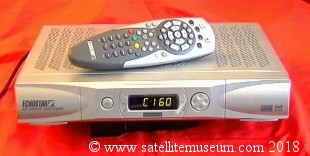
3rd row left - Strong 4375. 3rd right - Echostar 3000.
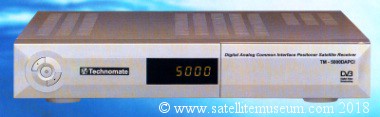
4th row left - Technomate 5500 DAPCI. 4th row right - Echostar 3600.
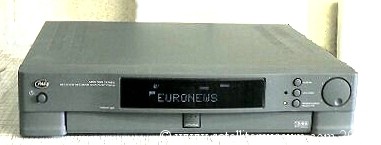
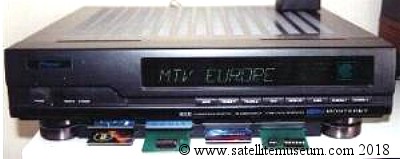

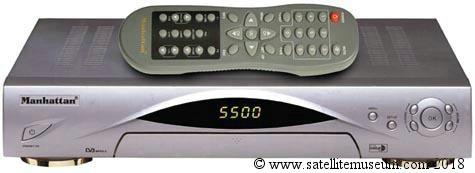
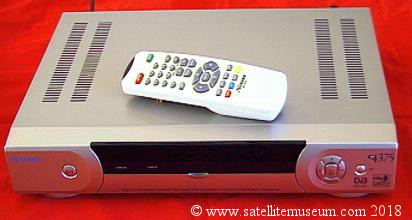
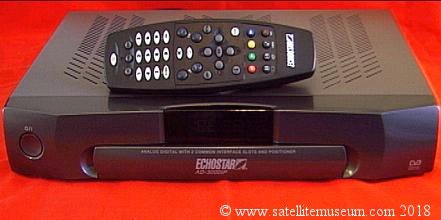
 Receiver positioners. The 2-box approach to motorized systems.
Good early examples are on this page. Very early examples are the Drake 3240 and Rochdale
100 (see receivers with knobs on) - both early 1980s. Then in 1987 came the Uniden 7001
and 771 (see it in this page.) In the early 1990s we had the Pace 800 (and 900) with
separate positioner. This was probably the most common motorized receiver set up in the
country until the Pace 508 came out. The 800/900 with positioner was unlike previous motorized
receivers that used the 2-box approach as the two boxes talked to each other down a scart
lead and acted like an integrated unit. Before the Pace 800/900 and positioner, motorised
2-box units had 2 remotes, one to move the dish and the other to select the channel.
with early units, the two boxes matched each other in appearance when stacked but
did not talk to each other.
Of all the units mentioned in this history section, the outstanding ones were the Monterey,
the Echostar 8700, the Drake 2000, the Echostar 3600 and 7000 and the Manhattan Plaza 36
volt motorised receivers, the st500, st550PVR and st450PVR
Another popular motorised receiver from the late 1980s was the Skyscan. Made in Canada.
See the special feature on the Skyscan above.
BSB, MAC and D2MAC. 1990
BSB promotional items & programme guides
BSB launched 5 channels on the 15th April 1990. The original launch date was the 30th Sept 1989 but
due to a problem with the supply of chips for the more advanced MAC receiver decoders, this date was
postponed. The 15th April was 15 months after the launch of Sky TV on the more powerful Astra 1
satellite and so it was to be an uphill battle to attract customers. Sky had been at lower power
on 13 east but when they moved to Astra 1 they could be received on a smaller 60cm dish. BSB
where on a very powerful satellite and even smaller dishes could be used. Only a few thousand BSB
receivers had been manufactured by April 1990 and supply problems continued throughout 1990.
In October 1990 two of the main BSB shareholders approached Sky about a merger as they were
loosing several millions of pounds a week. On the 2nd November 1990 BSB merged with Sky TV.
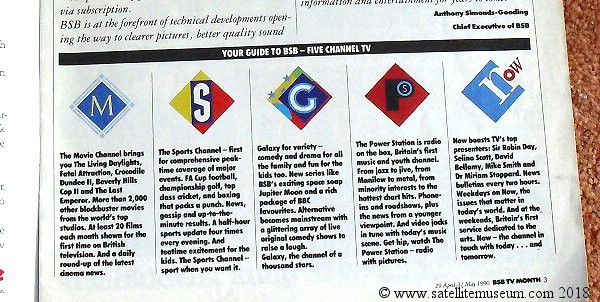
BSB (British Sky Broadcasting) offered 5 quality channels as part of it's package -
They were:- Galaxy - The Entertainment Channel, The Sports Channel, Now - The Channel for Living,
The Movie Channel and The Power Station.
Here are some promotional items from the launch of BSB in 1990-
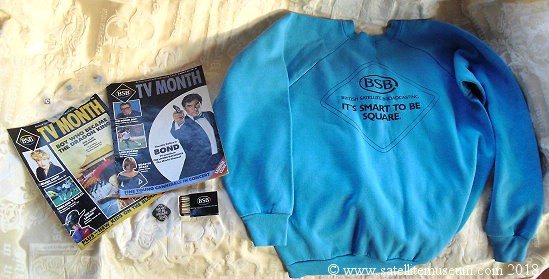
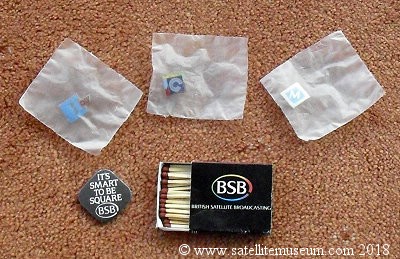
Shown above (left) is a BSB badge, a BSB box of matches and 3 BSB channel badges (showing channel logos)
in unopened poly bags. The channel badges are (from left to right) "Now", "Galaxy" and "The Movie Channel".
See below all five channel logos in a promotional advert from one of the programme guides including
details of what the five channels were showing.
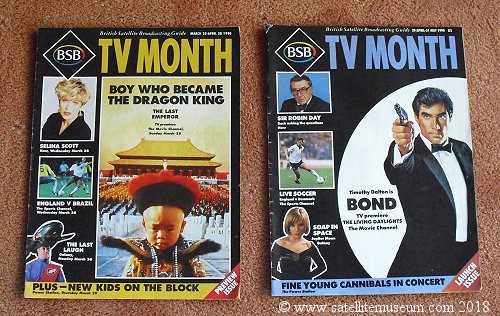
Also above are two BSB "TV Month" programme guide magazines. The one the left is the April 1990
edition and on the right the May 1990 edition. The April edition is important as it hit the
streets in March 1990, a couple of weeks before the April launch. The May edition is even
more important as it hit the streets in April 1990 for the launch of BSB. Indeed you can
see this is the actual launch issue.
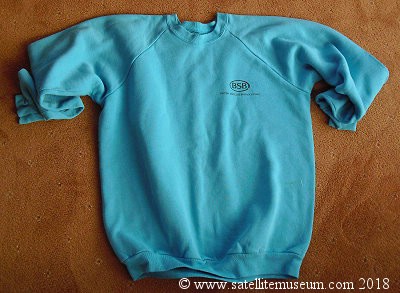
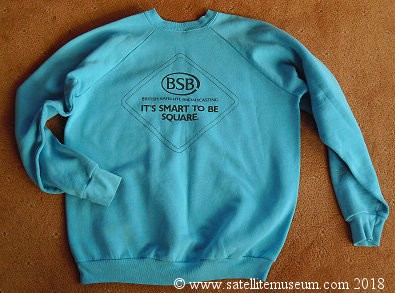
Below is a promotional BSB sweat shirt. The squarial was used as a selling point as the
rival programme provider, "Sky", used oval satellite dishes.
 The Philips BSB receiver.
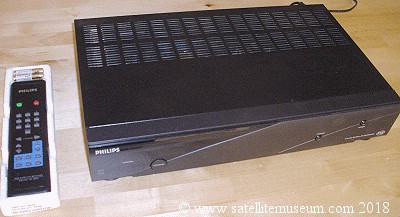
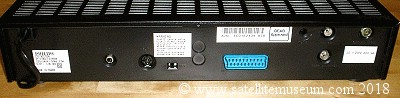
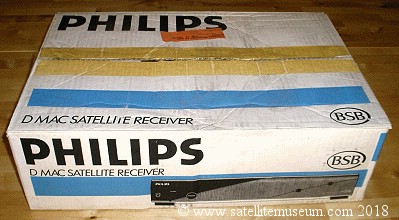
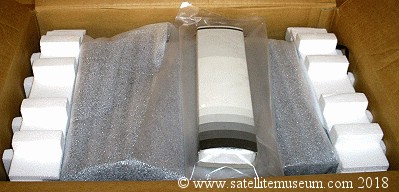 The Ferguson BSB receiver.
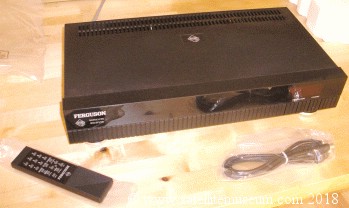
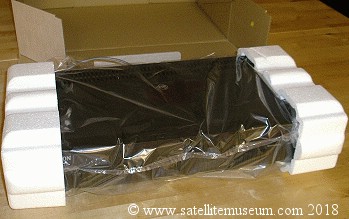
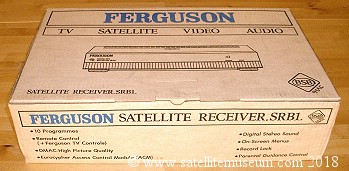
These units are complete with all packaging and manuals. They are in perfect condition.
Two unopened boxed squarial antennas. Philips and Ferguson.
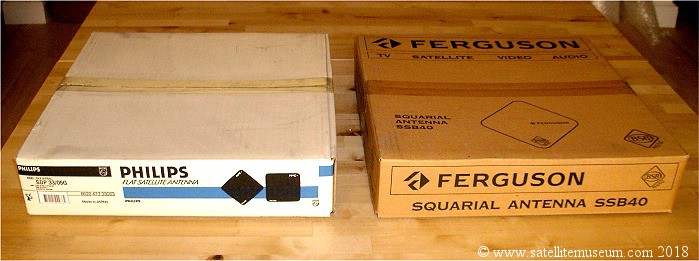 Boxed Philips 35cm BSB satellite dish.
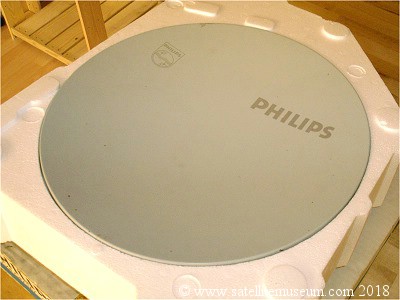
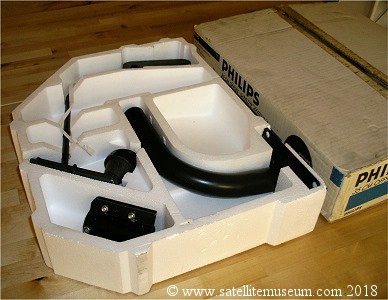
This powerful satellite could be received on a squarial or a 35cm dish. Even today some 30 years later
a 45cm Sky mini dish on Astra 2 struggles to provide enough signal unless the weather is good.
I can remember, at the time, testing a 35cm dish through double glazed glass and it still worked perfectly.
MAC and D 2 MAC was a late analogue television system of potentially better picture quality than standard
PAL analogue. In those days there were 4 television standards, PAL for Europe, NTSC for the States,
SECAM for France and the new higher quality MAC system. D2 MAC was used by some television providers
and a D2MAC decoder could be added to a standard receiver either via a scart lead or it could be embedded
BSB was a satellite television broadcast company, like Sky today, that used a satellite to broadcast 5 channels
in the high quality MAC system. In addition to the quality, the satellite was higher power and small dishes
could be used. Many of these "dishes" were of the flat Squarial type and some were small 35cm dishes.
The system was popular due to the very small dish sizes required (even by today’s standards).
BSB were in direct competition to Sky Television, who, at the time, were transmitting from the Astra 1
satellite at 19E. At the time I remember going to what was then called "The Cable and Satellite" show
at Olympia in London. I think it was 1989. That was the first time I ever saw the famous
"Chaparral Monterey" receiver. Anyway, Sky had a big exhibition stand and so did BSB.
(Remember BSB was offering 5 channels.) At the entrance to the Sky stand, on the floor, was a walkway
outlined with tape and written on the floor in the middle of the walkway were the words,
"WALK THIS WAY FOR 8 CHANNELS". Clearly a direct boast that Sky had more channels that their rival BSB!
As detailed above BSB got into difficulties and Sky took them over in 1990. As far as Sky was concerned,
the MAC system was discontinued and the satellite moved to a different position. It was then used by
the Scandinavian broadcasters who continued to transmitted in the MAC system.
The BSB name lived on to an extent as Sky TV changed their name to B Sky B.
The 1st Sky TV receivers.
The 1st ever dedicated Sky System.
1989. The Amstrad Fidelity SRX200 receiver
and Videocrypt decoder.
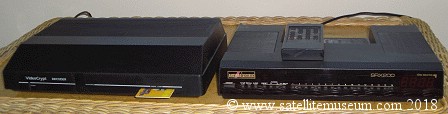
Sky Television had been available in the clear for some time using free to air receivers but
in 1989 the Amstrad Fidelity SRX200 satellite system was introduced.
Several features made this an industry first.
It was supplied specifically for the analogue Sky channels which were, at that time, being transmitted
from Astra at 19E. It was a 16 channel receiver that had 16 pre-set channels tuned to the Sky frequencies
on 19E. This made it unsuitable for other satellites or packages as the tuner was not infinitely variable.
It could not be altered for other frequencies on different satellites.
The dish was designed for reception of Sky TV from the UK.
The price was low and affordable - for the first time most people would be able to afford satellite TV.
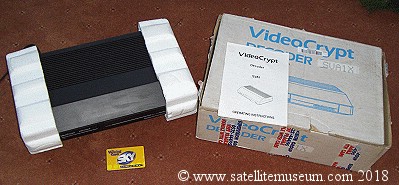
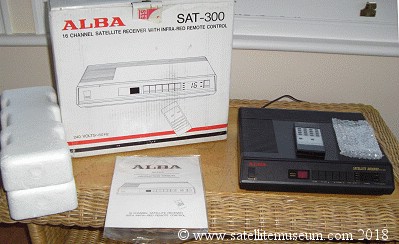
When Sky scrambed some of it's channels, a Videocrypt decoder was needed for the subscription card. This unit
was connected to the receiver by a lead. It acted as a decoding device like a modern digital cam.
You can see above a Videocrypt decoder complete with box, packaging and manual. Alba also produced a
16 channel receiver very similar to the Amstrad unit and a boxed sample is also in the collection.
The blue cap voltage switching single band LNB is shown further down this page. Since it used 13/18 volts
to switch from vertical polarity to horizontal polarity (not using a polariser) only one cable was needed
between the LNB and receiver making it easier to install.
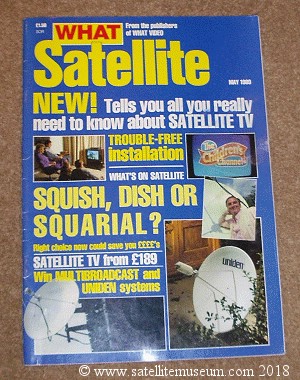
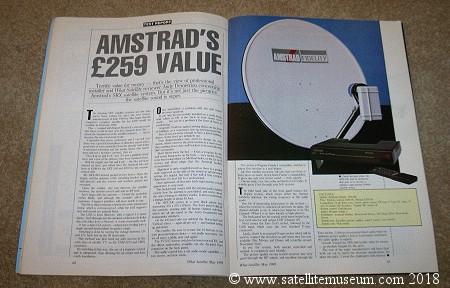
What Satellite Magazine May 1989
The 1st ever integrated decoder
Sky System.
1990. The Amstrad Fidelity SRX400 receiver.
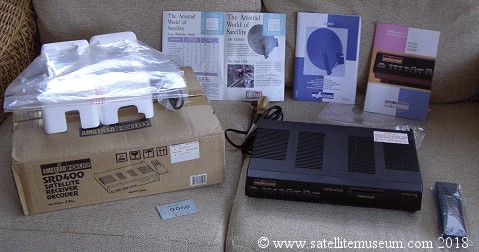
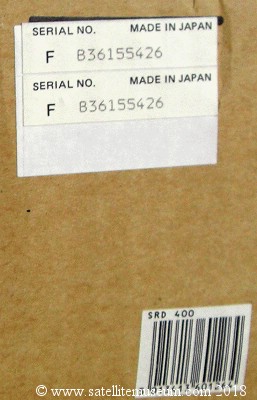
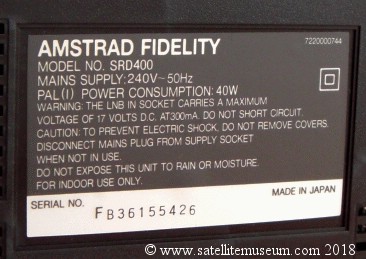
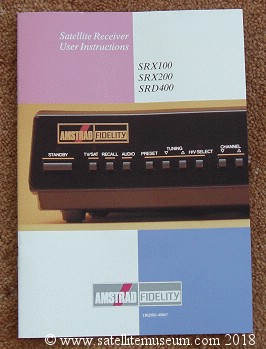
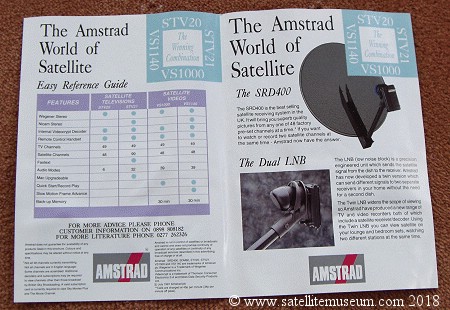
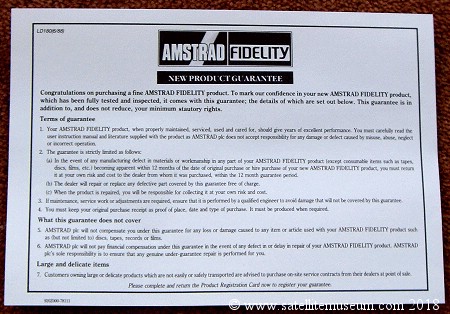
This is a complete kit. Original box - all serial numbers match. All accessories and manuals.
This was the first ever Sky receiver which had an embedded decoder to take a Sky card.
The embedded decoder was a Videocrypt decoder and the Sky card was inserted into the card reader.
The Amstrad 400 was a dedicated 48 channel receiver for Sky programs and free programs when
they were originally transmitted on Astra 1 at 19E in analogue.
Analogue & digital viewing cards.
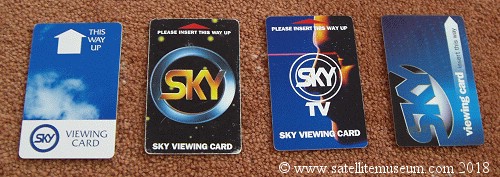
Four early Sky TV analogue viewing cards. Left to right, 07, 09, 10, and 11. If anyone
has an earlier Sky card than an 07, we would be interested in a donation.
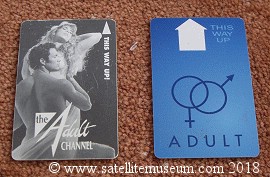
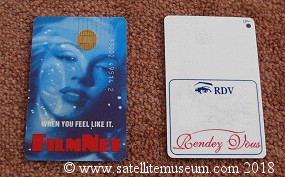
On the left above, two analogue "Adult Channel" cards. The one on the left is the earliest.
On the right above, two D2MAC analogue cards. The one on the left is for a movie channel "Filmnet"
and on the right, the adult channel "Rendez Vous".
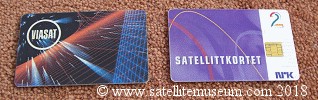
Above, two analogue D2MAC cards. The left hand card is for TV 1000 and on the right NRK
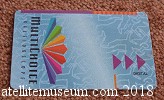
This digital card is for the Dutch Multichoice package and is in the IRDETO system.
The History of Blind Search Satellite Receivers.
2004 The Coship CDVB3188C
The first real blind search receiver.
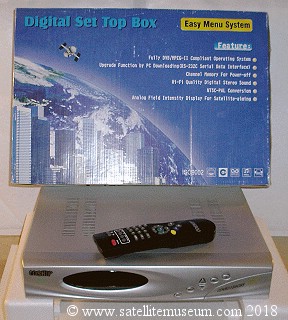
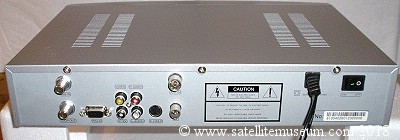
This receiver was sold by our company during 2004. These days blind search is the norm but
in 2004 some receivers had limited blind search capability. That is to say they were finding
a number of channels without the frequency data being in their data base, however, the
search was not at all thorough and most new channels and feeds were missed.
The Coship was the first receiver to offer a thorough blind search capability.
It only had 1500 memory locations and so it had to be used as a tool. Blind search
one satellite, transfer the new channels to a standard receiver manually, factory
reset the Coship, then move on the next satellite. Modern blind search receivers
have 10000 + channel memory locations.
Notes on Blind Search receivers.
The first ever blind search receiver was the RSD 300 except the manufacturers did not
really know what blind searching was, enthusiasts basically discovered the hidden
qualities of the chip set and clever scanning software. Shown below is the
RSD ODM 302CI. The
300 was free to air and the 302CI was the same as the 300 apart from the addition of CI slots.
2000 The RSD ODM 302CI
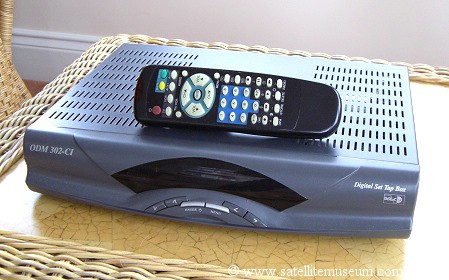
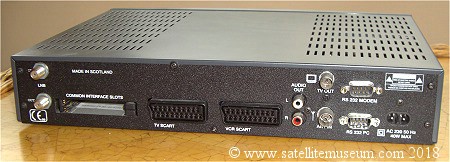
The ODM 300 board, converted into a free to air version, was fitted into the SCT Monterey
but the Monterey version had some irritating software problems.
The 300 was then licensed to "Newwave" and became the NW9000 but again the software
was modified and the general opinion was that the original 300 was the best.
The receivers channel search mode found channels which were not in it's own internal
software database. It had both auto FEC and auto symbol rate. However, the channel
search mode was not as thorough as the advanced search in a modern blind search
receiver. Not sure of the exact date of the 300 but could have been about 2000.
The Coship CDVB3188C was one of the first real blind search receivers on the market
and very good at that time. The Technomate and Manhattan Plaza range of receivers
were the best blind search of all receivers on the market in 2006.
Fortec Star receivers were also good blind search receivers
Only Manhattan in the st500 and st550 offered thorough blind search and 36 volt
positioning for motorised systems using heavier duty motors and/or larger dishes.
Only Manhattan offered thorough blind search with PVR options, the 250, 350 and 550.
So the st550 had thorough blind search, 36V positioning and Diseqc and PVR
options - and multistandard - and multivoltage. It it's day it was a very good
flagship motorised receiver. See it below.
2005 The Manhattan Plaza ST 550.
The first ever 36 volt motorised digital
(PVR) receiver with blind search.
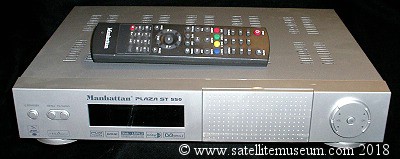
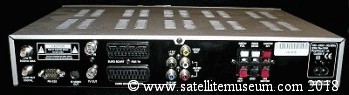
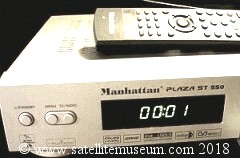
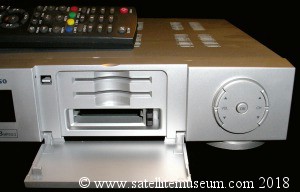
The Manhattan 550 was introduced at the beginning of 2005. It had a built in 36V positioner.
The early software did have blind search but it was not very thorough. By mid 2005 a large leap
forward was made with the 70 software. This software contained what many in the industry agreed
to be the most thorough blind search available. More improvements followed. The 550 was available
from some dealers with a 120 Gb AV hard drive. In mid 2005 our parent company introduced the
160Gb AV drive version of the 550. In May 2006 a new AV (audio video) 200gb hard drive was
fitted into the 550 by our parent company providing about 100 hours of recording capability.
In April 2005 the Manhattan 550 received the "What Satellite" magazine's
"Best Premium Satellite Receiver" award. In Feb. 2006 it was retested with the latest software and
received "What Satellite" magazines "Gold Award - 90%" with comments "Blind search faster and
smarter than ever" In late 2006 the 550 hardware was developed further and an improved heavy
duty, larger current, positioner power supply was fitted to drive larger motorised dishes.
2002 The Echostar DVR-7000.
The first ever 36 volt motorised digital PVR receiver.
(Hard drive built in.)
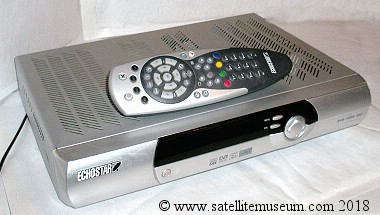
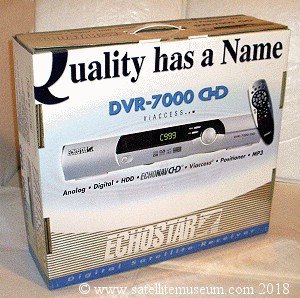
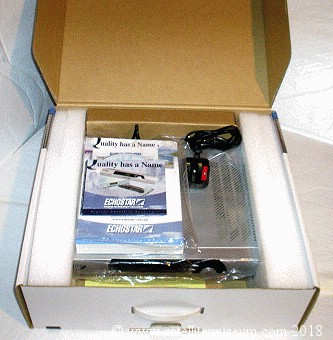
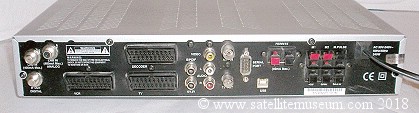
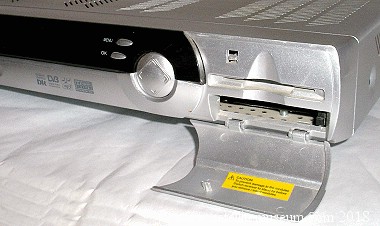
Two CI slots, embedded via access, 5000 channels, SVHS and Dolby Digital. 36 volt 5 amp
positioner and 40Gb hard drive. Diseqc switching but not compatible with Diseqc motors.
Introduced by Echostar in Dec. 2002 this unit was based on an Echostar 3600 but with a
40 Gb hard drive built in. It was probably the best receiver Echostar ever made but it
was discontinued from the market far too early. The software could have been developed
further. It was introduced with the 100 software and this was upgraded once to the
200 software but no further. Larger hard drives could have been fitted.
The main problem with this receiver was the high price (about £600) and this
resulted in low volume sales. It was prematurely discontinued in January 2003
after only 13 months. There is one in the museum. Fully boxed and perfect.
1980s block type LNBs.
NEC LNB.
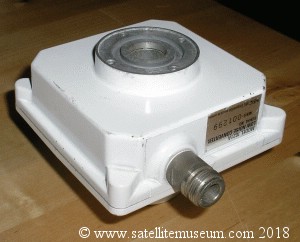
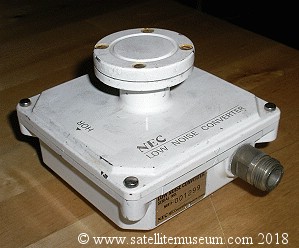
This LNB has a C120 flange for fitting on a feedhorn.
Notice that polarity had to be changed manually by actually rotating the LNB through
90 degrees using the knob on the back of it.
This item has been in my possession since the early 1990s. It was given to me by a supplier
when he found out I was a collector of "old stuff". It is difficult to date this item.
Very early 1980s is as close as I can estimate.
Avantek (sold by SAT-TEL) LNB.
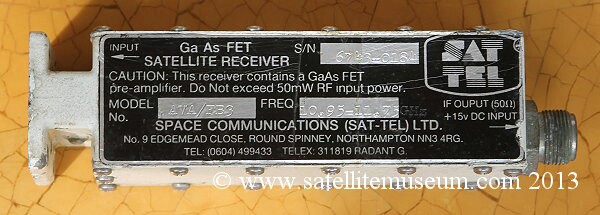
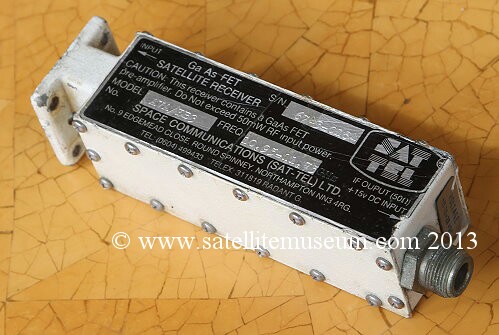
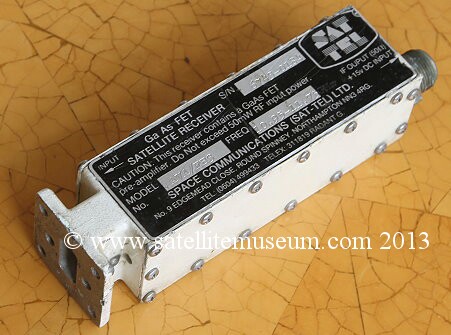 A Gallium Arsenide FET pre-amplifier in this LNB for microwaves was a first achievement.
This LNB was sold by Space Communications (Sat-Tel) Ltd. This company was formed on the 1st June 1982.
It is very unusual to find a satellite products company before 1985. The company description was - "Telecommunications".
It traded from Norfolk House, 499 Silbury Boulevard, Milton Keynes, MK9 2HA. Curiously the address on the LNB
is different. In 1993 the company went into receivership and in 1994 it was dissolved. As for the date of this
LNB - 1984/85 approx. This is a single band LNB (10.95 Ghz - 11.75GHz) It uses a Ga As FET transistor. That means
it uses Gallium Arsenide field effect transistors. These were known for their low noise and ability to work
at microwave frequencies. F Connectors became the industry standard, however the larger N connectors were
used in the early days of satellite TV. This LNB has a WR 75 flange and would bolt onto a magnetic or
mechanical polariser or directly onto a feedhorn for single polarity use. If anyone remembers this UK company,
maybe you can send us an email. Since "Avantek" is imprinted of the neck of the LNB, it is clear this LNB was
manufactured by Avantek. The LNB has been badged by SAT-TEL but was manufactured by Avantel Inc. Avantec Inc. was
formed in 1965 and was taken over by HP (Hewlard Packard) in 1991. Later sections of the company were sold off
and formed new companies. Avantec made LNBs and amplifiers for the satellite industry.
Their registered address was Avantek, Inc. Milpitas, CA 95035 and they traded from 4401 Great America Parkway
Santa Clara, CA 95054 USA. On the 8/8/91 the Los Angeles Times quoted a purchase sum of $82.9 million.
"The merger with Avantek, a Santa Clara-based maker of microwave semiconductors, components and assemblies,
is expected to be completed this fall."
Avantek, Inc. was founded in late 1965 to meet the electronic industry's need for high performance solid state VHF,
UHF and microwave transistor amplifiers. Avantek's achievements in the early 1980s led to the LNBs shown above -
1981 Avantec made the industry's first 1 Watt,4-€ GHz GaAs FET amplifier.
1982 Avantec made the industry's first 4.0+ GHz GaAs FET.
1983 Avantec made the industry's first 6.5-40G Hz GaAsF ETY G-tuned oscillator.
1984 GaAsm onolithic amplifiers introduced. Industry's first 18-40 GHz GaAs FET amplifiers
This would help confirm an approximate date for the LNB as 1984/85
Whilst C band in the early to mid 1980s was fairly common, a KU band LNB working at 10 & 11GHz was new.
Maspro LNB.
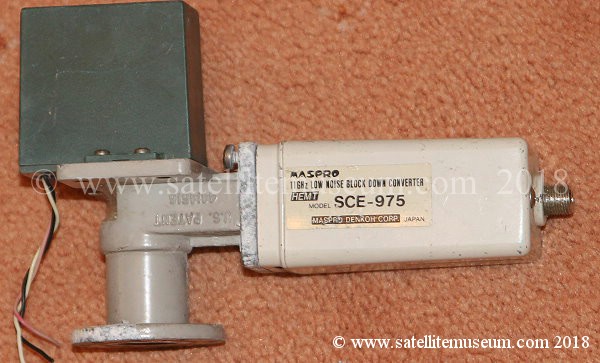
My very first satellite receiver in 1989 was a Maspro SRE90R. I only had it for a very short time and replaced
it with a Chaparral Monterey. It was purchased from a satellite trade distributor called "Micro X" in the UK.
This is a Maspro Denkoh Corp single band block type LNB from the mid to late 1980s. Made in Japan. It is bolted
onto a Chaparral polariser. Maspro are still in business today. From their
web page - Founded in 1952.
Manufacturer of TV antennas. Currently still selling TV reception equipment and satellite receivers.
Early 1990s block type LNBs.
In the late 1980s and early 1090s, the single band block type LNB was replaced very briefly with a dual band but
quickly followed by a triple band and then a quad band LNB. The two examples below are of block type quad band LNBs.
These LNBs are similar in performance to a modern universal LNB as they cover the same 4 frequency bands, covering
10700 - 12750GHz. However, the local oscillator frequency on the high band is different (10750Ghz) and high band is
13/18V voltage switched and the polarity is controlled with either a magnetic or mechanical polariser as shown in
the pictures of the Gardiner LNB below. Compared to a universal LNB, the separate polariser meant that skew
adjustment was possible by the user at the receiver. See a
Gardiner LNB patent filing
1991.
Gardiner.
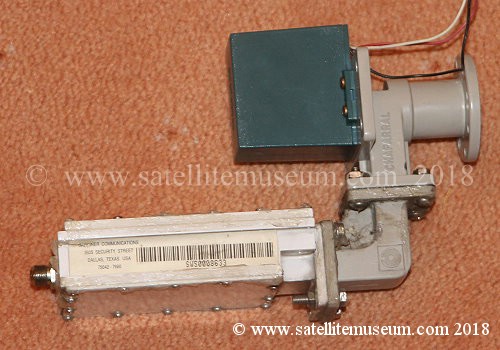
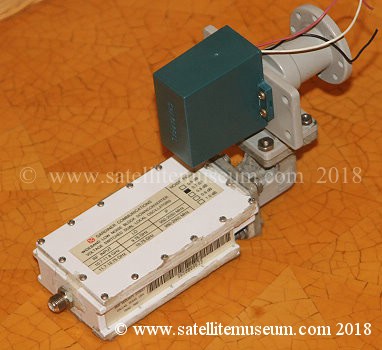
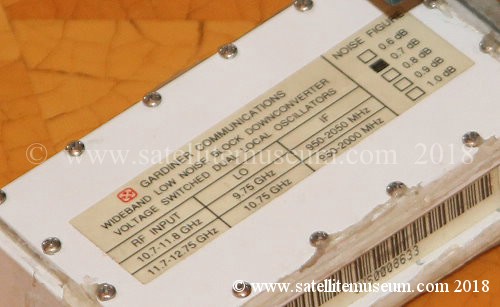
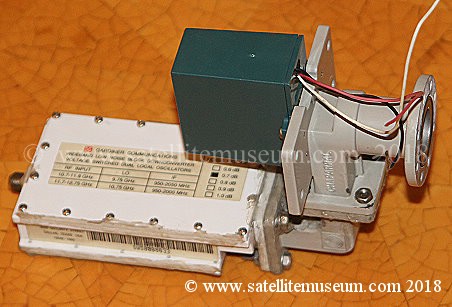
Gardiner Communications Corp made some very high quality LNBs. A well respected brand. Located at
3605 Security Street Dallas Texas USA, they started in 1992. The US company looks like it is no longer
active and the trade mark may have been purchased by an Indian company. See
more information.
Chaparral
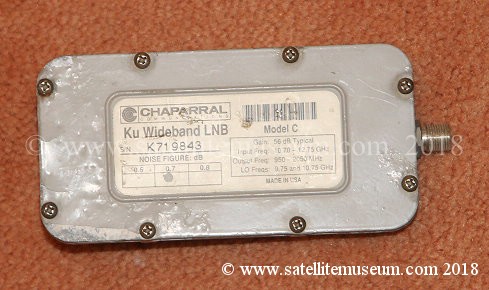
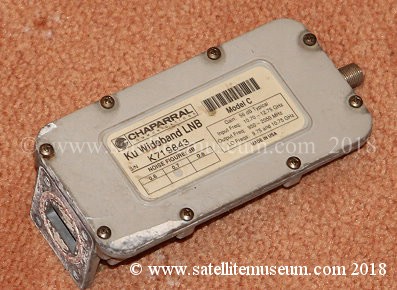
Chaparral Communications quad band lock type LNBs were very good and widely used. All of the mechanical polarisers in
the pictures are made by Chaparral. Chaparral still make LNBs and polarisers today. Price £169.00
Blue Cap and 23mm LNB.
Late 1980s to mid 1990s voltage switching LNBs.
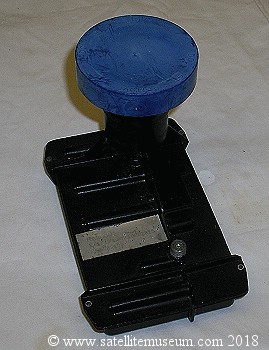
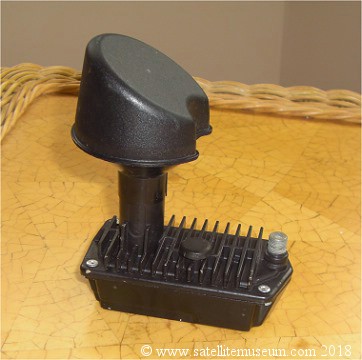
The Blue Cap LNB on the left was the standard voltage switching LNB fitted to 60cm dishes
set to receive Sky analogue when Sky was on Astra 1 at 19 degrees east. The first Amstrad
dishes were packaged with this LNB. (See the Amstrad 1989 review below with Blue Cap LNB
fitted to the white offset dish.) At first dishes were white but a little later, most
60cm dishes were the black mesh type. The Sky systems had Videocrypt decoders.
The LNB had a local oscillator frequency of 10,000MHz and was a single band LNB.
Once voltage switching LNBs had been introduced, this was the most common LNB
of that type used in the early days of Sky TV on Astra 1.
The 23mm neck LNB was less common and fitted a particular make of offset dish that
used a 23mm LNB clamp rather than the more common 40mm clamp. Again this was
a voltage switching single band LNB.
The History of LNBs (Low Noise Blocks).
The pictures below show LNBs and polarisers that are in the museum.
To understand how LNBs evolved from the 1980s onwards we need to first look at how an LNB works and,
in particular, the frequency bands it deals with. The common band used for satellite TV is the KU band.
The modern universal LNB scans this band and can receive and process signals from 10700 up to 12750 GHz.
In simple terms, the LNB collects the electromagnetic radiation and down converts it from GHz to MHz
frequencies. It also amplifies the signal (like an aerial mast-head amplifier) and tries very hard not
to introduce “noise”. (In Hi Fi terms noise sounds like a background hiss in the speaker but in satellite
TV it affects the LNB’s capability to capture a “clean” picture.) Too much noise reduces the all important
“signal too noise ratio”: that is the difference between clean signal and noise. The signal to noise ratio
must be as large as possible. An LNB with a “high gain” is able to “drive” the signal down longer cables.
The satellite dish parabolic reflector collects the Electromagnetic radiation and reflects it into the
feedhorn (flared end and cap) of the LNB. It is then sensed (induced) and converted to electricity in a
small sensor at the end of the LNB. At these high MHz frequencies the signal is still a combination of
radiation and electricity and so the coaxial cable is a combination of electrical conductor and wave guide
(which is why high quality LNB cable should be used).
The radiation entering the feedhorn needs to be polarised in the vertical or horizontal plane. That is so
that more channels can be carried on a satellite since two transponders can have the same frequency but
opposite polarities. One can be vertical and the other horizontal. By having a 90 degree difference in the
polarity between two signals of identical frequencies; the two signals do not then interfere with each other.
Also note that a digital transponder can carry a number of channels (all of the same polarity).
In those early days, in the 1980s, “block-type” single band LNBs were used. These could only receive and
process frequencies from 10.900 to 11.700 GHz. The polarity was controlled by a polariser. This was an
extra device between a separate feedhorn (the horn collects the reflected radiation) and the LNB.
Two types of polariser we used: mechanical and magnetic. The mechanical polariser had the highest
performance as it had zero insertion loss but since is was a piece of wire that turned vertically and
horizontally by a small motor, it could seize up in the winter. The magnetic polariser polarised the
signal vertically and horizontally using a magnetic field in a solid state semi-conducting material.
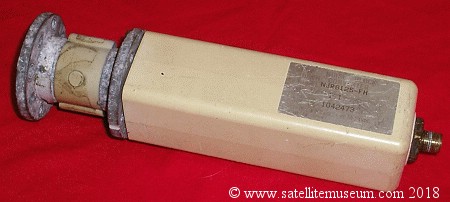
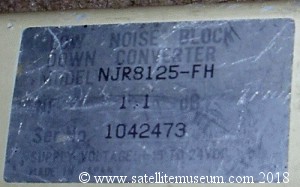
Above left - Magnetic polariser and 1.1dB single band LNB. Right - close-up of label.
These polarisers could become “noisy” after a couple of years. Modern LNBs simply have two conducting
sensors set at 90 degrees to each other each detected by the receiver switching from 13 to 18 volts.
This voltage (and current) also provides power to the LNB. In early receivers, polarity was changed by
the mechanical polariser’s motor-driven, 3-wire driving circuits or the magnetic polariser’s 2-wire
driving circuits from the receiver.
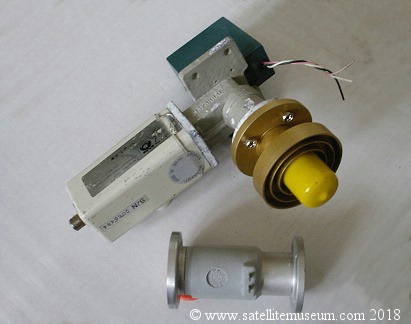
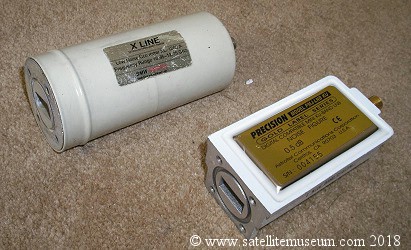
Above left - Chaparral mechanical polariser fitted to a gold feedhorn and a single band block type LNB
and below this combination, an "IRTE BU" magnetic polariser.
Above right - Type "A" Swedish Microwave (non-enhanced) X line block type triple band LNB and a
modern Astrotel quad band block type LNB.
Following the single band LNB were two LNBs, fed from a single feedhorn that split into a Y-shaped
device called an “OMT”. One LNB covered the FSS band (10.900 - 11.700 GHz) and the second LNB either
the DBS band (11.700 – 12.500 GHz) or the Telecom band (12.500 – 12.750 GHz). Clearly, all of these sub
bands are within the main KU band. The output from the two LNBs ran down two cables into two inputs of
the receiver and were switched accordingly by the receiver. In the early 1990s, the block-type dual band
LNB was introduced. This was actually two LNBs in the one LNB package and the receiver accessed each ½ of
the LNB by using 13 to 18 volts from the receiver
(these days voltage switching is used to switch polarity not bands).
These LNBs were short lived and soon the block type triple band LNB was introduced
(remember all block-type LNBs use a mechanical or magnetic polariser system) and this covered the KU band
from 10.900 – 12750. The last block-type LNB to be introduced was the quad band LNB: again, two LNBs in
the one LNB package, one coving the bands from 10.700 to 11.700 and the other from 11.700 to 12.750 GHz.
Polarity was switched by a polariser and the band by 13/18 volts.
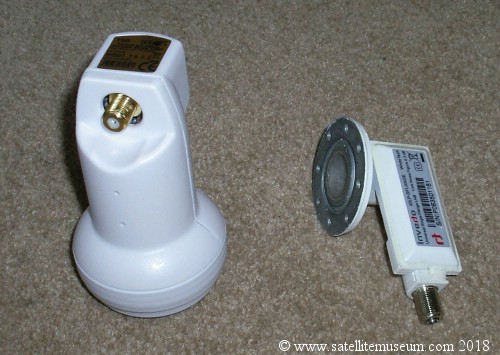
Above - modern universal LNBs, 40mm and c120 flange types.
Finally, in the mid to late 1990s the universal (also quad band) LNB was introduced. This also covered the
KU band from 10.700 to 12.750 but this time the bands (the two LNBs in the one package) were switched with
a 22Khz tone and the polarity was switched by 13 to 18 volts: 13V accessing the vertical conducting sensor
and 18V accessing the horizontal conducting sensor (the two sensors being positioned at 90 degrees to each other).
In our museum, our earliest LNB is an NEC unit where polarity was changed by physically rotating the LNB by
hand, using the knob on the end of it!
Update Feb 2011 - email received -
"I happened to notice your pictures of some NEC LNB’s which your text suggests are manually rotated to receive
either polarities. A long time ago I ran a system with 1 1.8m dish and these LNB’s. In my configuration – there
were two LNB’s, you can see from the fittings that the microwave path can run straight through one and
then into a second one. The two LNB’s were mounted 90 degrees out of phase and the two outputs were then
combined in a very large box which was strapped to the side of the dish mount – a single LNB cable
then ran back to the receiver."
Clearly the signal went through the 1st LNB to the 2nd one and then into it. The two LNBs were at 90
degrees to each other. This was an unusual way of mounting LNBs
OMTs.
The "OMT" was a common method of dealing with two polarities from a satellite. The two LNBs, each at
90 degrees to each other, one collecting vertical polarisation and the other horizontal polarisation
were bolted to a Y shaped OMD wave guide. This unit was bolted to the feedhorn and collected the
microwaves from the dish and fed them to both LNBs. The coaxial outputs of the two LNBs connected
to two cables, the other end being connected to the receiver and the receiver switched to each LNB for
each polarity. Chaparral used there own version of "OMT" type waveguide - see
Chaparral dish
kit. where
the OMT (Orthomode transducer) waveguide was not Y shaped but did the same job. See this OMT above
Polarisers.
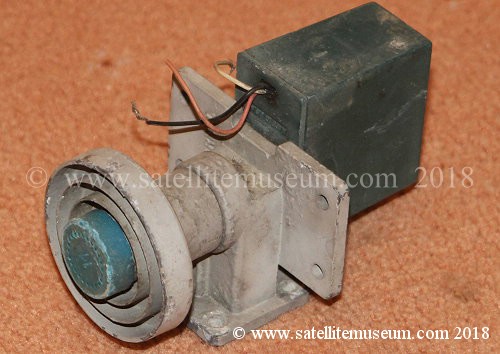
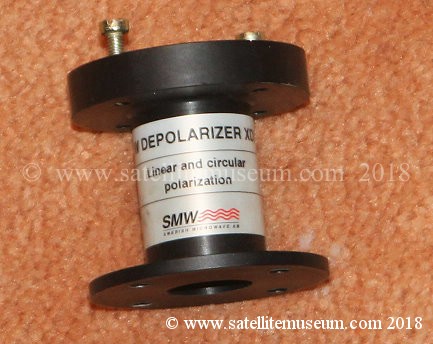
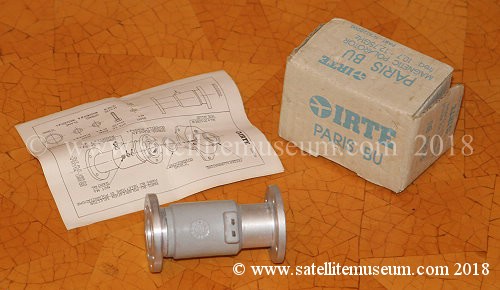
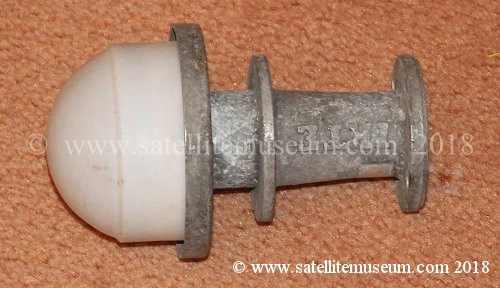
In the days when block type LNBs were standard equipment on all dishes (typically 1985-1995) and before
voltage switching LNBs, the polarity was changed using either a magnetic or mechanical polariser. The
most common types were made by IRTE and
Chaparral. The IRTE was a magnetic type, the wave was
polarised in a magnetic field. The Chaparral used a wire on the end of a motor which turned to
correctly align the wave to be of the correct polarity. The disadvantage of the magnetic polariser
is that, with age, it could become "noisy" losing it's performance. The disadvantage of the
mechanical polariser is that (especially in the winter) the shaft from the motor to the wire
sensor would seize-up in it's bearing and not turn. The Chaparal polariser was available with
or without an integral feedhorn. The one shown above is a combined polariser and feedhorn.
Also shown above is an IRTE feedhorn. Also shown above is a Swedish Microwave linear to
circular depolariser. All of these products were for the Ku band.
The cable and Satellite Show 1986.
1986 show guide brochure.
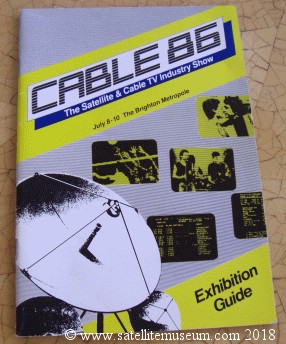
1986 was really in the very early days of satellite TV. The annual show in the UK was called The Cable and
Satellite show. Many exhibiters from that time have long since disappeared.
See What Satellite magazines from the late 1980s on the
Old satellite publications page.
A UK satellite enthusiast video 1982
Go to
www.youtube.com and then search for 'Satellite TV Reception.
On the menu that comes up scroll down until you find a 10 minute item -
'Satellite TV Reception Enthusiast' Steven J Birkill. Recorded in 1982. Steves used an 8 foot dish.
In the mid 80s when he left "BBC Transmitters" for Bob Cooper's satellite setup in Oklahoma.
This all fell apart a couple of years later and Steve returned to the UK, It is rumoured that
he was involved with designing the Amstrad front end of their first satellite receiver range
A TV-DXers Handbook by
Roger Bunney. 1986.
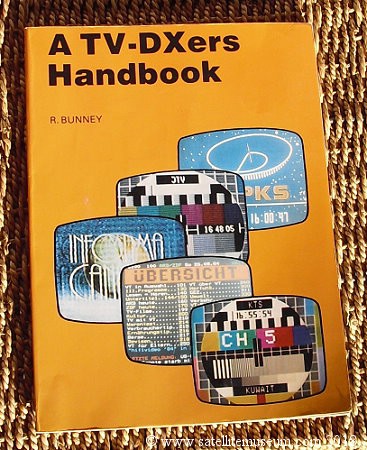
This book comprehensively covers all aspects of the analogue tv systems at the time and includes two
chapters on satellite tv. Footprint maps are included and they show three satellites which include UK
coverage on the 11GHz band in 1986. These satellite transmitted from 13E, 7E and 27.5W.
"Satellite Television" by Peter Pearson.
1987
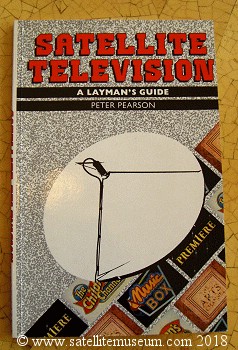
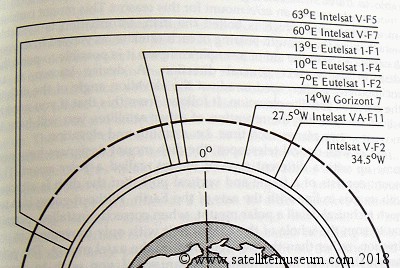
We are very grateful to Peter for providing a signed copy of this historic publication.
First published in 1987 it explains the basics of satellite TV to a public who, at the time
only knew about the 4 channels available from an aerial. Very few people in the UK in 1987 had
either satellite TV or cable. Indeed the satellites were low power requiring a fairly large dish
and whilst the channel choice was wide compared to terrestrial TV, it was very limited
compared to the digital choice today. A small extract from the book is shown on the right
and the main satellites available at the time are detailed. Clearly 13E was just as
important in 1987 just as it is today. Peter also contributed some old satellite receivers
to the museum including the Triax 2000S shown higher up this page.
An advert for 90cm prime focus
dishes from 1989.
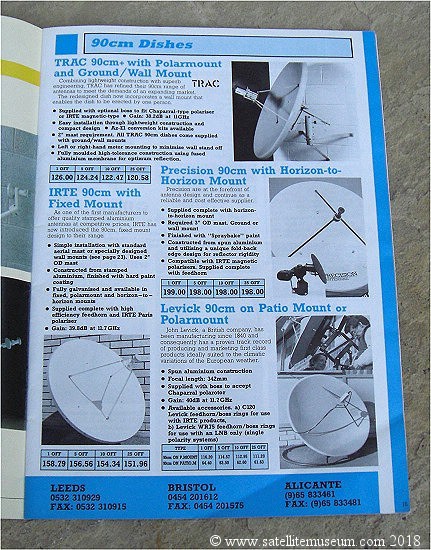
 Making a donation.
The Rewind Museum is a non-profit making endeavour. The web site and the touring exhibitions are run on
a voluntary basis. Donations,
not money, just old items you no longer want, are always welcome.
If you have something that you think would be of interest, please contact us with the details.
We can send in a courier to pick them up. (Even an international courier). Thank you.
Please note - The Rewind Museum site has been archived by the British
Library so that future generations can always access the site's content.
To talk to us about making a donation please go to - "
making a donation".
Are you interested to read about a 10 year + restoration of a classic vehicle?
If so go to -
www.1952chevytruck.com
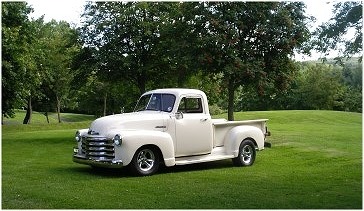 The 1952 The 1952 Chevy truck web site.
Web site copyright © 2018 Vision International. All rights reserved.
For all questions & comments about this site's content contact Dave at Rewind Museum.